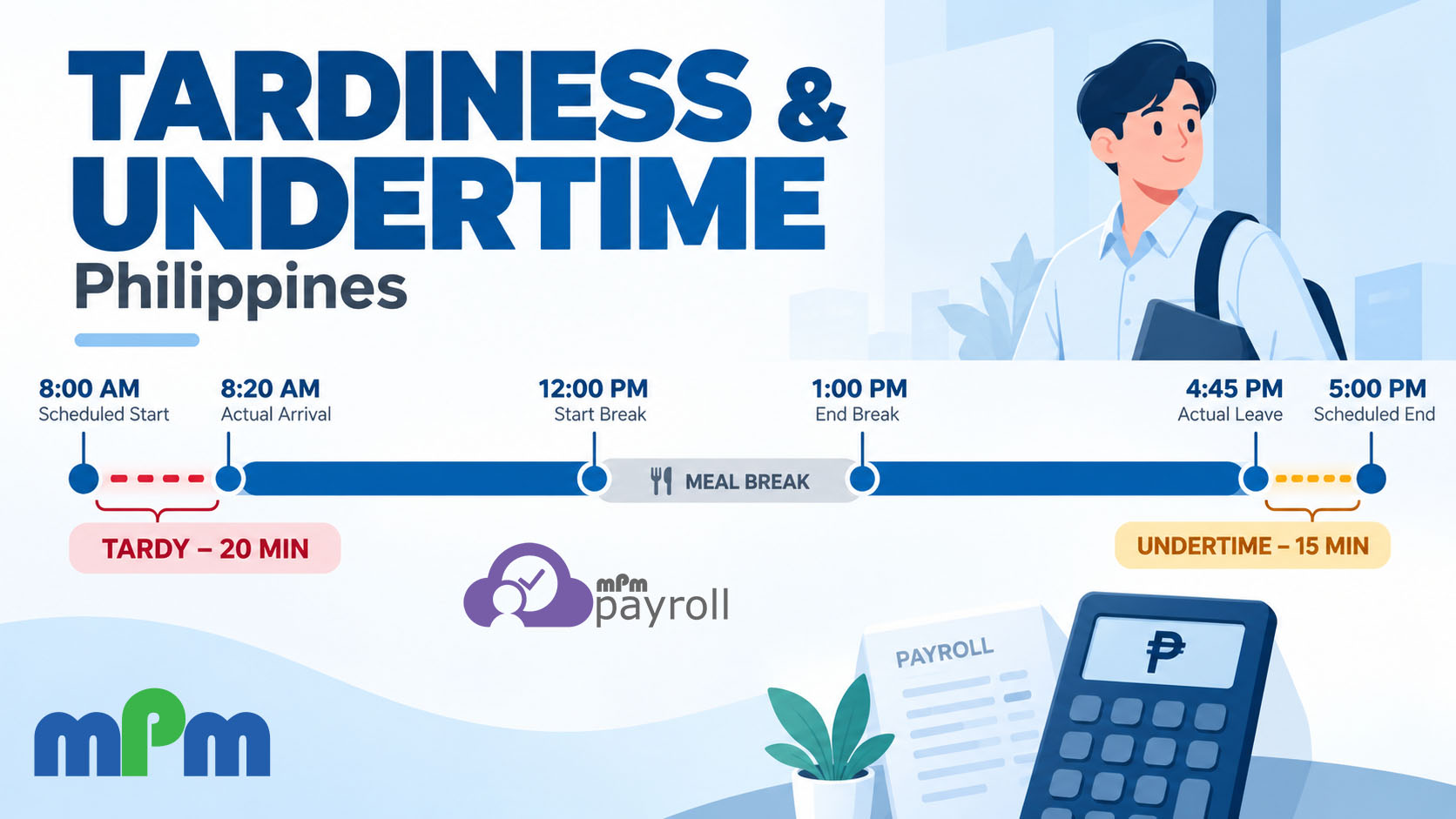
Tardiness and undertime are among the most common attendance adjustments that affect payroll in the Philippines.
The basic computation is relatively simple: determine the employee’s hourly or per-minute rate and multiply it by the amount of scheduled working time that was not worked. In actual payroll processing, however, several questions can make the calculation more complicated.
What happens when an employee returns late from lunch? Is there a mandatory grace period? Can an employee who arrives late still earn overtime? Can an employer disallow overtime if the employee was late? Do tardiness and undertime affect 13th month pay? And what happens when the attendance gap occurs on a holiday or rest day?
This guide explains these situations and how they can affect payroll.
Tardiness vs. Undertime: What Is the Difference?
Tardiness and undertime both represent scheduled working time that an employee did not work. The distinction generally depends on when the attendance gap occurs and on the attendance policy or payroll system used by the employer.
Different employers and payroll systems may use slightly different classifications. For payroll purposes, the more important consideration is correctly identifying the employee’s scheduled working time and the portion that was not actually worked.
What Is Tardiness?
Tardiness, commonly called being late, generally occurs when an employee reports for work after the required start of the workday.
In MPM Payroll, tardiness specifically refers to the gap between the employee’s scheduled start of work for the day and the employee’s first arrival.
For example:
- Scheduled start: 8:00 AM
- First clock-in: 8:20 AM
- Tardiness: 20 minutes
Once the employee has reported for work, subsequent gaps in attendance during the workday are classified by MPM Payroll as undertime when those gaps represent scheduled working time that was not worked.
What Is Undertime?
In MPM Payroll, undertime refers to scheduled working time that was not worked after the employee’s first arrival for the day.
The most common example is leaving before the scheduled end of the workday:
- Scheduled time out: 5:00 PM
- Actual time out: 4:30 PM
- Undertime: 30 minutes
However, undertime can also occur in the middle of the workday.
Suppose the employee’s scheduled lunch break is from 12:00 PM to 1:00 PM but the employee returns at 1:15 PM:
- Scheduled return: 1:00 PM
- Actual return: 1:15 PM
- Undertime: 15 minutes
Similarly, if the employee leaves early for lunch:
- Scheduled start of break: 12:00 PM
- Actual clock-out: 11:45 AM
- Undertime: 15 minutes
If the employee leaves at 11:45 AM and returns at 1:15 PM for a scheduled 12:00 PM–1:00 PM break, the employee has a total of 30 minutes undertime.
A Simple Way to Understand the Difference
Under MPM Payroll’s attendance classification:
Scheduled time missed before first attendance → Tardiness
Scheduled time missed after first attendance → Undertime
| Attendance Scenario | MPM Payroll Classification |
|---|---|
| Scheduled at 8:00 AM, arrives at 8:15 AM | 15 minutes tardiness |
| Leaves at 4:45 PM instead of 5:00 PM | 15 minutes undertime |
| Returns from a 12:00–1:00 PM break at 1:15 PM | 15 minutes undertime |
| Leaves for lunch at 11:45 AM instead of 12:00 PM | 15 minutes undertime |
| Leaves at 11:45 AM and returns at 1:15 PM | 30 minutes undertime |
Other employers or payroll systems may use different terminology, particularly for attendance gaps during breaks. Regardless of the label used, the important payroll consideration is determining the amount of scheduled working time that was not worked.
Why Can a Late Return Be Classified as Undertime?
Different companies and payroll systems may classify attendance gaps differently.
In MPM Payroll, tardiness refers to scheduled working time missed before the employee’s first attendance for the day, while undertime refers to scheduled working time missed after the employee has already reported for work.
This distinction also works for employees with multiple attendance records during the day. For example, a field or project worker may clock out after working on Project A and later clock in for Project B. If there is an unworked gap between the two assignments that overlaps with scheduled working time, MPM Payroll can classify the gap as undertime rather than describing the employee as “late” again.
The same approach applies to early breaks, late returns from breaks, early departures, and other gaps in scheduled working time.
Importantly, a gap between clock records is not automatically undertime or unpaid time.
Under Article 84 of the Labor Code, hours worked include time during which an employee is required to be on duty or at a prescribed workplace, as well as time during which the employee is suffered or permitted to work.
For example, if the period between Project A and Project B involves required and compensable travel between work locations, the absence of a clock record does not by itself establish that the employee had undertime.
The employer must first determine whether the gap actually represents scheduled working time that was not worked.
Are Tardiness and Undertime the Same as Absence?
Not necessarily.
An absence normally means an employee did not work during a period when they were required to work. Tardiness and undertime usually represent only part of the employee’s scheduled working time.
For example, an employee scheduled to work eight hours who arrives one hour late may still have seven hours of regular work for the day.
Payroll should therefore account for the employee’s actual compensable working time rather than automatically treating an attendance deficiency as a full-day absence.
Can Employers Deduct Tardiness and Undertime From Salary?
The Labor Code provides that normal hours of work generally shall not exceed eight hours a day for employees covered by its hours-of-work provisions. It also defines hours worked to include time when an employee is required to be on duty or at a prescribed workplace and time when an employee is suffered or permitted to work.
When an employee does not work part of the required working period because of tardiness or undertime, the corresponding unworked time can affect the employee’s basic pay.
However, employers should distinguish between an adjustment representing actual unworked time and an additional monetary penalty imposed as discipline.
Company policies, employment agreements, collective bargaining agreements, and more favorable established practices should also be considered.
How to Compute Tardiness
The first step is to determine the employee’s applicable hourly and per-minute rate.
Step 1: Determine the Daily Rate
For a daily-paid employee, the applicable daily wage can generally be used as the starting point.
For monthly-paid employees, the equivalent daily rate depends on the applicable salary factor or divisor.
The correct daily-rate calculation should be determined first rather than arbitrarily dividing the monthly salary by a particular number of days. You can learn how to compute employees daily rate in this article.
Step 2: Determine the Hourly Rate
For an employee with an eight-hour normal workday:
Hourly Rate = Daily Rate ÷ 8
Suppose:
- Daily rate: ₱800
- Normal working hours: 8 hours
The hourly rate is:
₱800 ÷ 8 = ₱100 per hour
Step 3: Determine the Per-Minute Rate
Per-Minute Rate = Hourly Rate ÷ 60
Using the same example:
₱100 ÷ 60 = ₱1.666666… per minute
Step 4: Determine the Tardy Minutes
Suppose:
- Schedule: 8:00 AM–5:00 PM
- Meal break: 12:00 PM–1:00 PM
- Actual time in: 8:25 AM
The employee has:
25 minutes tardiness
Step 5: Calculate the Tardiness Deduction
Tardiness Deduction = Per-Minute Rate × Tardy Minutes
Therefore:
₱1.666666… × 25 = ₱41.67
The employee’s tardiness deduction is ₱41.67.
When calculating payroll, it is generally preferable to retain sufficient decimal precision during intermediate calculations and apply the appropriate rounding at the final amount.
How to Compute Undertime
The same basic calculation can be used for undertime.
Suppose:
- Daily rate: ₱800
- Hourly rate: ₱100
- Schedule: 8:00 AM–5:00 PM
- Meal break: 12:00 PM–1:00 PM
- Actual time out: 4:15 PM
The employee has 45 minutes undertime.
The formula is:
Undertime Deduction = Hourly Rate ÷ 60 × Undertime Minutes
Therefore:
₱100 ÷ 60 × 45 = ₱75
The employee’s undertime deduction is ₱75.
How Do Break Times Affect Tardiness and Undertime?
Breaks are important because payroll should determine the employee’s scheduled working periods, rather than simply calculating the difference between the first Time In and last Time Out.
Article 85 of the Labor Code generally requires employers to provide employees with at least 60 minutes for their regular meal period, subject to applicable exceptions.
Shorter rest periods are treated differently. Under the implementing rules, rest periods or coffee breaks of 5 to 20 minutes are considered compensable working time.
For example, if an employee has a scheduled 15-minute coffee break from 10:00 AM to 10:15 AM, that period is generally still counted as hours worked. The employee should not automatically lose 15 minutes of basic pay simply because no productive work was performed during the break.
This is different from a regular meal period, which is generally at least 60 minutes and is ordinarily excluded from hours worked.
There are also limited circumstances where an employer may provide a meal period of not less than 20 minutes instead of the usual 60 minutes. When a shortened meal period is permitted under the applicable rules, it must be counted as compensable hours worked.
Now consider a regular schedule with a one-hour unpaid meal period:
- Work: 8:00 AM–12:00 PM
- Meal break: 12:00 PM–1:00 PM
- Work: 1:00 PM–5:00 PM
The total span from 8:00 AM to 5:00 PM is nine hours, but there are only eight scheduled working hours because the one-hour meal period is excluded.
If the employee clocks out at 12:00 PM but returns at 1:15 PM, the additional 15 minutes from 1:00 PM to 1:15 PM represents scheduled working time that was not worked.
In MPM Payroll, this is classified as 15 minutes undertime.
If the employee instead clocks out at 11:45 AM and returns at 1:00 PM, there is also 15 minutes undertime because the employee stopped working 15 minutes before the scheduled meal period.
If the employee clocks out at 11:45 AM and returns at 1:15 PM, the employee has:
- 15 minutes undertime before the meal period
- 15 minutes undertime after the meal period
- Total undertime: 30 minutes
This is why an attendance system should evaluate attendance against the employee’s actual work schedule and break schedule rather than simply looking at the employee’s first Time In and final Time Out.
It should also distinguish compensable short rest periods from unpaid meal periods. A scheduled 15-minute coffee break, for example, should not automatically be treated as 15 minutes of undertime simply because the employee was not actively performing work during that period.
Why Tardiness and Undertime May Not Appear on the Payslip
Tardiness and undertime do not always appear as separate deductions on an employee’s payslip. The presentation can depend on how the employee’s basic pay is computed.
This is particularly noticeable when comparing daily-paid and monthly-paid employees.
Daily-Paid Employees
For daily-paid or hourly-paid employees, basic pay may be calculated directly from the employee’s actual compensable working time.
For example:
Basic Pay = Actual Compensable Hours × Hourly Rate
Suppose:
- Daily rate: ₱800
- Hourly rate: ₱100
- Required work: 8 hours
- Actual compensable work: 7 hours
Basic pay can simply be calculated as:
7 hours × ₱100 = ₱700
There may be no need for the payslip to present the computation as:
₱800 Basic Pay − ₱100 Tardiness/Undertime = ₱700
The missing hour has already been accounted for because only the employee’s actual compensable working hours were included in basic pay.
The attendance system may still record that hour as tardiness or undertime for attendance monitoring, but there may be no separate tardiness or undertime deduction on the payslip.
Monthly-Paid Employees
For monthly-paid employees, payroll is often presented differently because the computation may begin with a fixed basic salary for the payroll period.
For example:
- Basic salary for the payroll period: ₱15,000
- Tardiness and undertime adjustment: ₱500
The payslip may therefore show:
Basic Salary: ₱15,000
Less: Tardiness/Undertime: ₱500
The attendance deficiency is more visible because it is presented as an adjustment to the employee’s fixed basic salary.
Same Payroll Effect, Different Presentation
Consider an employee with a daily rate of ₱800 who has only seven compensable hours for the day.
One payroll presentation could be:
7 hours × ₱100 = ₱700 Basic Pay
Another could be:
₱800 Basic Pay − ₱100 Tardiness/Undertime = ₱700
The resulting basic pay is the same, but the presentation is different.
Therefore, the absence of a separate tardiness or undertime deduction on a payslip does not necessarily mean that the attendance deficiency was ignored.
It may already have been factored into basic pay through the number of compensable hours actually worked.
This is another reason to distinguish:
Attendance classification → what happened during the employee’s scheduled working time
from:
Payroll presentation → how the resulting earnings and adjustments are displayed on the payslip.
What Is a Grace Period for Tardiness?
A common misconception is that Philippine labor law automatically gives employees a 10-minute or 15-minute grace period before they can be considered late.
The Labor Code’s general hours-of-work provisions do not establish a universal 10- or 15-minute grace period for all private-sector employees.
Employers may nevertheless provide a grace period through company policy, an employment agreement, collective bargaining agreement, or established practice.
How Can a Grace Period Work?
Suppose:
- Scheduled start: 8:00 AM
- Company grace period: 10 minutes
- Actual arrival: 8:07 AM
How those seven minutes are treated depends on the employer’s policy.
A grace period can potentially mean different things.
For example, an employee arriving within the grace period might not be considered tardy for disciplinary or attendance-monitoring purposes.
A company may instead provide a paid grace period, where employees arriving within the allowed period receive no payroll adjustment.
Employers should therefore clearly define whether their grace period affects:
- attendance classification;
- payroll computation;
- disciplinary action; or
- all of the above.
A vague grace-period policy can easily result in inconsistent payroll treatment.
Can Employees Make Up for Tardiness by Working Later?
This is one of the more complicated questions involving tardiness.
Consider:
- Schedule: 8:00 AM–5:00 PM
- Meal break: 12:00 PM–1:00 PM
- Actual time in: 8:30 AM
- Actual time out: 5:30 PM
It might initially appear that the employee has:
30 minutes tardiness + 30 minutes overtime
But that is not necessarily the case.
Article 87 of the Labor Code provides for overtime compensation for work performed beyond eight hours a day.
In this example:
8:30 AM–12:00 PM = 3.5 hours
1:00 PM–5:30 PM = 4.5 hours
Total actual work = 8 hours
For purposes of determining whether the statutory eight-hour threshold for overtime has been exceeded, the employee has rendered only eight hours of work.
The additional 30 minutes after the scheduled 5:00 PM time out therefore does not automatically become overtime merely because it occurred after the scheduled end of the shift.
However, this does not mean that an employee automatically has the right to arrive late and unilaterally extend the workday to make up the missing time.
The employee’s established schedule, the employer’s authorization rules, applicable company policies, and any more favorable employment arrangement must still be considered.
Can Tardiness or Undertime Be Offset Against Overtime?
It is important to distinguish completing eight hours on the same day from actually offsetting earned overtime.
Article 88 of the Labor Code expressly provides that undertime work on one particular day cannot be offset by overtime work on another day.
For example:
- Monday: 1 hour undertime
- Tuesday: 1 hour overtime
The employer should not simply cancel the two.
What About the Same Day?
Suppose an employee arrives 30 minutes late but stays 30 minutes beyond the scheduled shift.
If the additional 30 minutes merely brings the employee’s total actual work to eight hours, the statutory overtime threshold may not yet have been exceeded.
But suppose the employee has actually completed eight hours and then renders another 30 minutes of qualifying overtime.
The tardiness and overtime should not simply be treated as equal monetary amounts.
For an employee earning ₱100 per hour:
30 minutes of unworked regular time:
₱100 × 0.5 = ₱50
If 30 minutes qualifies as ordinary-day overtime, Article 87 requires the regular wage plus at least 25% for the overtime work:
₱100 × 125% × 0.5 = ₱62.50
The monetary values are different.
This is why payroll should determine tardiness, undertime, regular hours, and qualifying overtime separately, rather than simply subtracting attendance minutes from overtime minutes.
Can an Employer Disallow Overtime if the Employee Is Late?
Employers may establish policies governing when employees are authorized to render overtime, including rules intended to prevent employees from extending their working hours without approval.
For example, a company may require employees to obtain authorization before rendering overtime.
However, overtime authorization and compensation for work actually performed are separate issues.
Employers should distinguish:
“You were late, so you are not authorized to render overtime today.”
from:
“The company required or permitted you to perform qualifying overtime, but it will not be paid because you were late.”
Article 84 includes within hours worked time during which an employee is suffered or permitted to work, while Article 87 requires the applicable additional compensation for overtime work covered by the provision.
An attendance or overtime-authorization policy should therefore not be confused with the employer’s obligation to properly compensate qualifying work that the employer actually required, suffered, or permitted the employee to perform.
Does Working After the Scheduled Time Automatically Mean Overtime?
Not necessarily.
Suppose:
- Schedule: 8:00 AM–5:00 PM
- Meal break: 12:00 PM–1:00 PM
- Time in: 9:00 AM
- Time out: 6:00 PM
Actual work is:
9:00 AM–12:00 PM = 3 hours
1:00 PM–6:00 PM = 5 hours
Total = 8 hours
Although the employee worked until 6:00 PM, the employee completed eight hours of actual work.
Article 87 establishes the statutory overtime rule for work beyond eight hours a day. Accordingly, time occurring after an employee’s scheduled time out does not, by itself, establish that the statutory eight-hour threshold has been exceeded.
Again, this does not mean employees may freely change their work schedules. Schedule compliance and overtime entitlement are related but distinct issues. You may refer to this article if you want to have deep dive on how to compute overtime pay in the Philippines.
What if the Employee Works More Than Eight Hours Despite Being Late?
Consider:
- Schedule: 8:00 AM–5:00 PM
- Meal break: 12:00 PM–1:00 PM
- Time in: 8:30 AM
- Time out: 6:00 PM
Actual work:
8:30 AM–12:00 PM = 3.5 hours
1:00 PM–6:00 PM = 5 hours
Total = 8.5 hours
The employee has rendered eight and a half hours of actual work.
The portion beyond eight hours may therefore qualify for overtime compensation under Article 87, assuming the employee is covered by the overtime provisions and the work otherwise meets the applicable requirements.
The employee’s earlier tardiness does not by itself eliminate qualifying overtime that was actually rendered.
What About Flexible Work Schedules?
Tardiness cannot always be determined simply by comparing an employee’s arrival against one company-wide starting time.
Suppose an employee has:
- Allowed start: 7:00 AM–9:00 AM
- Required working time: 8 hours
- Actual start: 8:30 AM
The employee would not necessarily be tardy simply because another employee started at 7:00 AM.
Some flexible arrangements may also establish core hours during which employees must be present while allowing flexibility before and after those hours.
The applicable schedule and company policy must therefore be determined before calculating tardiness or undertime.
How Do Tardiness and Undertime Affect Holidays and Rest Days?
Tardiness and undertime can affect holiday and rest-day pay differently from an ordinary working day.
A useful starting question is:
Is the employee paid for the day even if no work is performed?
This helps distinguish compensation that the employee may already be entitled to receive from additional compensation attributable to actually working on the holiday or rest day.
Regular Holidays
Under DOLE holiday-pay rules, qualified employees who do not work on a regular holiday are generally entitled to 100% of their daily wage, subject to the applicable conditions.
If the employee works on the regular holiday, the applicable rate is generally 200% of the daily wage for the first eight hours of work. Different rules apply when the regular holiday also falls on the employee’s rest day or when overtime is rendered.
For payroll purposes, it is therefore useful to distinguish:
Holiday-pay entitlement for the unworked regular holiday
from:
Compensation for work actually performed on the regular holiday
If an employee works only part of a regular holiday, employers should apply the applicable holiday-pay rules to the actual circumstances rather than automatically treating the missing hours as an ordinary-day tardiness or undertime deduction.
Special Non-Working Days
Special non-working days are different.
DOLE guidance provides that the “no work, no pay” principle generally applies to a special non-working day unless a favorable company policy, practice, or collective bargaining agreement grants payment even when no work is performed.
When an employee works on a special non-working day, the applicable rate for the first eight hours is generally 130% of the basic wage. If the special day also falls on the employee’s rest day, the applicable first-eight-hours rate is generally 150%.
Where the employee is not paid if the special day is unworked, payroll can determine compensation based on the actual compensable work performed at the applicable rate.
If the employer provides a more favorable policy under which the special day is paid even when unworked, that policy must also be considered.
We have a separate guide on types of holidays and how it affects payroll if you want to take a deep dive into the topic.
Rest Days and Monthly-Paid Employees
The treatment of rest days can also depend on how the employee is paid.
DOLE/NWPC guidance recognizes monthly-paid employees who are paid every day of the month, including unworked rest days, special days, and regular holidays. The 365-day factor used in determining their equivalent monthly rate includes these days.
For an employee whose monthly compensation already covers an unworked rest day, payroll should distinguish the compensation already included in the monthly salary from the applicable additional compensation for actually working on the rest day.
For employees who are not considered paid on an unworked rest day, compensation for rest-day work can instead be based on the actual compensable work performed at the applicable premium rate.
Attendance Classification Is Not Always a Separate Deduction
An attendance system may still identify late arrival, early departure, or another attendance gap on a holiday or rest day.
But that does not necessarily mean payroll should create a separate “tardiness” or “undertime” deduction.
Depending on the employee’s compensation arrangement and the type of day, the attendance deficiency may already be reflected through:
- fewer compensable work hours;
- fewer holiday-work hours;
- fewer rest-day work hours; or
- a separate attendance adjustment to fixed basic pay.
This is similar to the distinction between daily-paid and monthly-paid employees discussed earlier.
Do Tardiness and Undertime Affect 13th Month Pay?
Yes, they can.
DOLE explains that statutory 13th month pay is generally computed as:
Total Basic Salary Earned During the Calendar Year ÷ 12
If tardiness or undertime results in basic salary not being earned, it can consequently reduce the employee’s statutory 13th-month-pay base.
Example
Suppose an employee earns:
- Monthly basic salary: ₱30,000
- Annual basic salary before attendance adjustments: ₱360,000
Without any reductions:
₱360,000 ÷ 12 = ₱30,000
Now suppose ₱3,000 of basic salary was not earned during the year because of tardiness and undertime.
Basic salary actually earned:
₱360,000 − ₱3,000 = ₱357,000
13th month pay:
₱357,000 ÷ 12 = ₱29,750
The difference in basic salary earned therefore produces a corresponding difference in statutory 13th month pay.
Common Mistakes When Computing Tardiness and Undertime
Using the Wrong Daily Rate
For monthly-paid employees, determine the appropriate equivalent daily rate and applicable salary factor before calculating the hourly and per-minute rate.
Assuming Undertime Only Happens at the End of the Day
An attendance gap can occur anywhere within scheduled working time.
An employee who leaves early for lunch, returns late from a break, or has an unworked gap between assignments may also have undertime under the employer’s attendance classification.
Treating Every Attendance Gap as Tardiness
Calling every subsequent arrival “late” becomes particularly confusing for employees who clock in and out several times during the day.
In MPM Payroll, only scheduled working time missed before the employee’s first attendance is classified as tardiness. Subsequent unworked gaps in scheduled working time are classified as undertime.
Treating Every Gap Between Clock Records as Undertime
The opposite can also cause incorrect deductions.
A gap in clock records does not necessarily mean the employee stopped performing compensable work.
The employee may be traveling between assignments, performing work that was not separately clocked, or otherwise required to remain on duty. The Labor Code’s rules on hours worked must still be considered.
Treating Short Rest Breaks as Unpaid Time
Under the implementing rules, rest periods or coffee breaks of 5 to 20 minutes are considered compensable working time.
For example, an employer should not automatically deduct a scheduled 15-minute coffee break from an employee’s compensable hours simply because the employee was not actively working during that period.
These short compensable rest periods should be distinguished from the regular meal period, which is generally at least 60 minutes and ordinarily excluded from hours worked.
Including Meal Periods as Working Hours
The span between first Time In and last Time Out does not necessarily represent actual compensable hours.
A regular one-hour unpaid meal period, for example, should generally be excluded when determining the employee’s actual working hours.
Assuming Employees Can Change Their Schedule to Make Up Tardiness
The fact that additional work later in the day may affect whether eight hours have been completed does not automatically give employees the right to change their established work schedule.
Company scheduling and authorization policies must still be followed.
Automatically Offsetting Tardiness Against Overtime
If the additional work merely brings actual work to eight hours, the statutory overtime threshold may not have been exceeded.
If qualifying overtime has actually been earned, its premium rate also means that its monetary value differs from ordinary regular-time compensation.
Offsetting Undertime on One Day Against OT on Another Day
Article 88 expressly prohibits offsetting undertime on one particular day against overtime work on another day.
Assuming There Is a Mandatory Grace Period
The Labor Code does not establish a universal 10- or 15-minute grace period for all private-sector employees. Employers may establish their own policies subject to applicable laws, agreements, and more favorable practices.
Assuming Tardiness Must Appear as a Separate Payslip Deduction
For employees whose basic pay is calculated from actual compensable hours, tardiness and undertime may already be reflected through fewer paid hours.
A separate deduction is not necessarily required to produce the same payroll result.
Treating Holiday or Rest-Day Attendance Like an Ordinary Workday
First determine the type of day, whether the employee is already entitled to payment even without working, the employee’s compensation arrangement, and the actual compensable work performed.
Holiday and rest-day premium rules can produce a different payroll result from an ordinary working day.
Rounding Too Early
Avoid repeatedly rounding intermediate hourly and per-minute rates. Small differences can accumulate across multiple days, employees, and payroll periods.
How MPM Payroll Computes Tardiness and Undertime
Manual calculations become considerably more complicated when employees have different schedules, multiple attendance records, breaks, holidays, rest days, overtime rules, and grace-period policies.
MPM Payroll integrates employee schedules, attendance, and payroll so attendance can be classified before payroll is computed.
In MPM Payroll:
- Scheduled working time missed before the employee’s first attendance can be classified as tardiness.
- Unworked gaps in scheduled working time after the employee’s first arrival can be classified as undertime.
- Early departures for breaks and late returns can be recognized as undertime.
- Multiple attendance records can be evaluated against the employee’s schedule.
- Compensable short rest periods can be distinguished from unpaid meal periods.
- Clock gaps can be reviewed in the context of the employee’s actual schedule and compensable work.
- Actual working hours can be used when determining applicable overtime and premium compensation.
- Holiday and rest-day computations can take into account the employee’s applicable pay arrangement.
- Tardiness and undertime can be reflected either as separate payroll adjustments or through the employee’s actual paid hours, depending on how basic pay is computed.
This allows payroll to consider the employee’s actual schedule and attendance rather than relying solely on the first Time In and final Time Out.
If you prefer not to manage these payroll complexities internally, you can also outsource the entire process to MPM through our Outsourced Payroll Services.
Our team can handle payroll processing for you, including attendance adjustments, tardiness, undertime, overtime, holidays, rest days, and other payroll computations, so your internal team can focus on running the business.
Frequently Asked Questions
What is the difference between tardiness and undertime?
In MPM Payroll, tardiness refers to scheduled working time missed before the employee’s first attendance for the day. Undertime refers to scheduled working time missed after the employee has already reported for work.
Is returning late from lunch tardiness or undertime?
In MPM Payroll, if an employee’s scheduled lunch is from 12:00 PM to 1:00 PM but the employee returns at 1:15 PM, the additional 15 minutes is classified as undertime.
How do you calculate tardiness?
Hourly Rate ÷ 60 × Tardy Minutes
How do you calculate undertime?
Hourly Rate ÷ 60 × Undertime Minutes
Are coffee breaks counted as working hours?
For example, a scheduled 15-minute coffee break is generally counted as hours worked rather than deducted as unpaid time.
Is lunch break counted as working time?
There are limited circumstances where a meal period of at least 20 minutes may be allowed instead. When such a shortened meal period is permitted under the applicable rules, it is counted as compensable working time.
Why isn't tardiness shown on my payslip?
For example, if a daily-paid employee’s basic pay is calculated using actual compensable hours multiplied by the hourly rate, the employee’s tardiness or undertime may already have reduced the number of paid hours. It therefore may not appear as a separate deduction.
Is there a mandatory 15-minute grace period in the Philippines?
An employer may establish a grace period through its policies or other applicable employment arrangements.
Can an employee make up for being late by working later?
If an employee works after the scheduled time out but has only completed eight actual hours, the statutory overtime threshold may not yet have been exceeded. The employer’s scheduling and authorization policies must still be considered.
Can tardiness be offset against overtime?
Additional work on the same day may simply bring actual work to eight hours rather than constitute statutory overtime. Where qualifying overtime has actually been earned, its premium rate also means that its monetary value can differ from regular-time compensation.
Article 88 also expressly prohibits offsetting undertime on one day against overtime on another day.
Can an employee who is late still receive overtime pay?
Being late does not by itself eliminate qualifying overtime that is subsequently rendered. Actual hours worked, employee coverage, and the applicable overtime rules should be determined.
Can an employer prohibit an employee who is late from rendering overtime?
However, preventing unauthorized overtime should be distinguished from refusing to properly compensate qualifying overtime work that the employer actually required, suffered, or permitted the employee to perform.
Does tardiness reduce 13th month pay?
If tardiness results in basic salary not being earned, it can reduce the employee’s total basic salary earned during the calendar year, which is the basis of the statutory 13th-month-pay computation.
Do tardiness and undertime apply on holidays?
For regular holidays, qualified employees may be entitled to holiday pay even without working, while employees who actually work are subject to the applicable holiday-work rates. Special non-working days generally follow the “no work, no pay” rule unless a more favorable arrangement applies.
Do tardiness and undertime apply on rest days?
The payroll effect depends on whether the employee is already considered paid for the unworked rest day and on the actual compensable work performed.
Computing Tardiness and Undertime Accurately
The basic mathematical formula for tardiness and undertime is straightforward:
Hourly Rate ÷ 60 × Minutes of Unworked Time
The more important – and often more difficult – part is determining which scheduled minutes were actually not worked and how those minutes should affect payroll.
Employers need to consider the employee’s schedule, meal periods, compensable short rest periods, actual compensable work, grace-period policy, overtime rules, day type, compensation arrangement, and whether a particular day is already paid even if unworked.
This also explains why simply comparing an employee’s first Time In and last Time Out is often insufficient. Attendance gaps can occur before lunch, after lunch, between assignments, or at other points during the workday. A gap in clock records also does not automatically mean that the employee was not performing compensable work.
The same attendance deficiency can appear differently in payroll. For a monthly-paid employee, it may appear as a separate adjustment to fixed basic salary. For a daily- or hourly-paid employee, it may already be reflected through fewer compensable hours. On holidays and rest days, the applicable pay and premium rules must first be determined.
MPM Payroll brings scheduling, attendance, and payroll together so attendance records can be evaluated against the employee’s actual schedule and incorporated into payroll based on the company’s configured rules.
Instead of manually reconciling schedules, multiple clock records, tardiness, undertime, overtime, breaks, holidays, and rest-day work separately, payroll administrators can review the resulting attendance classifications and payroll computations in one system.

Leave a Reply