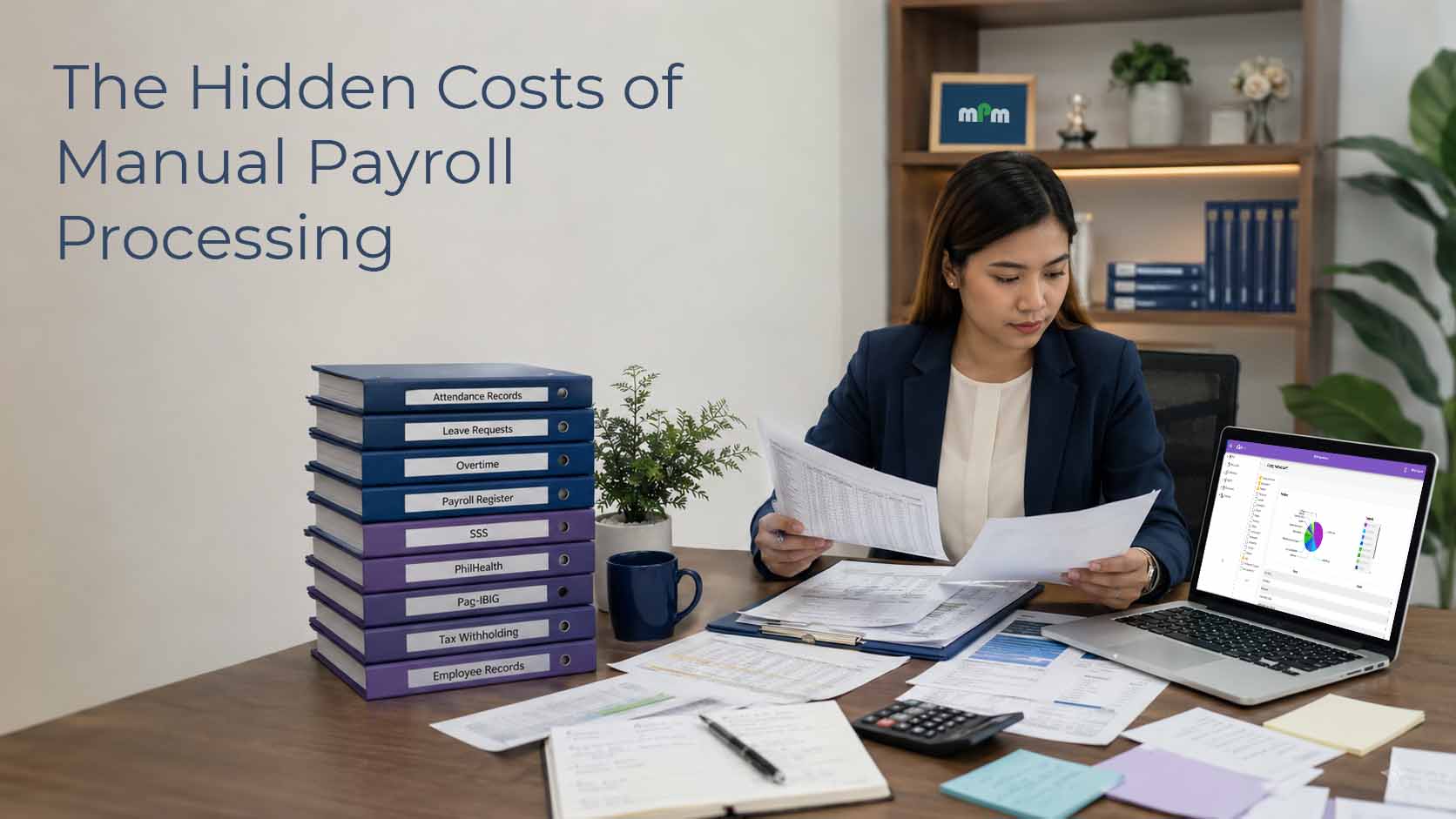
Many businesses continue to process payroll using spreadsheets or manual computations because it appears to be the most economical option. After all, if payroll is completed accurately and employees are paid on time, why invest in payroll software?
Since 2012, MPM has worked with businesses across various industries as they transitioned from manual payroll processes to a dedicated payroll system. During implementation, we often encounter similar operational challenges regardless of company size or industry.
The observations shared in this article are based on common issues we’ve seen while helping organizations migrate from manual payroll processing. While every business is different, many of the challenges we encounter are remarkably similar – not because businesses intentionally create inefficient payroll processes, but because manual payroll often evolves gradually over many years as organizations grow.
Manual payroll is not just about calculating salaries. It also involves attendance processing, leave management, overtime computation, government contributions, tax compliance, report generation, and maintaining accurate payroll records. As a business grows, these hidden costs often become much greater than the apparent savings of continuing with manual processes.
1. Time Is More Expensive Than You Think
Payroll is a recurring process that demands attention every payroll cycle. Even if each task only takes a few extra minutes, the total time spent every month can be substantial.
Manual payroll often involves:
- Consolidating attendance records
- Validating leave and overtime
- Computing salaries and deductions
- Preparing government reports
- Generating payslips
- Reviewing computations before payroll release
As the number of employees increases, the workload grows significantly. Time that could have been spent on improving operations, supporting employees, or serving customers is instead consumed by repetitive administrative work.
2. Payroll Errors Can Be Costly
Even experienced payroll personnel can make mistakes, especially when working with multiple spreadsheets and manual calculations.
Common errors include:
- Incorrect tax withholding
- Wrong overtime computation
- Missed allowances or deductions
- Duplicate payments
- Incorrect leave balances
- Incorrect overtime
These errors often lead to payroll adjustments, employee concerns, additional accounting work, and a loss of confidence in the payroll process.
Correcting payroll after it has been released usually takes far more effort than preventing the error in the first place.
3. Complex Payroll Policies Encourage Shortcuts
As organizations grow, payroll policies naturally become more complex.
Different employees may have different:
- Work schedules
- Salary structures
- Overtime policies
- Holiday pay rules
- Leave benefits
- Allowances and deductions
In our implementation projects, we’ve occasionally seen businesses rely on manual workarounds simply because their existing payroll process has become too complicated to manage consistently using spreadsheets.
Under tight payroll deadlines, payroll personnel may be tempted to simplify computations or rely on manual workarounds to complete payroll on time.
Examples we’ve encountered include:
- Rounding overtime hours up or down instead of using the employee’s actual recorded time.
- Applying simplified computations to avoid handling different payroll scenarios individually.
- Computing withholding tax or government contributions using an employee’s fixed monthly salary even when the actual payroll earnings for the period differ because of absences, unpaid leave, overtime, bonuses, commissions, or other payroll adjustments.
- Manually overriding payroll computations without documenting the reason.
- Maintaining multiple spreadsheets to handle exceptions that the primary payroll worksheet cannot accommodate.
These workarounds are often introduced with good intentions – to save time or meet payroll deadlines. However, we’ve observed that temporary shortcuts can gradually become the organization’s standard payroll process simply because they have been used for many years.
Over time, employees and managers become accustomed to these practices, making them increasingly difficult to change. In some situations, long-standing payroll practices may also require careful legal review before they can be modified because Philippine labor law recognizes the concept of company practice under the principle of non-diminution of benefits. Whether a particular practice has acquired this status depends on the specific facts and applicable law, but it illustrates why temporary payroll shortcuts should never become permanent policies without careful evaluation.
The longer these undocumented workarounds remain in place, the greater the risks:
- Employee overpayments or underpayments
- Inconsistent payroll computations
- Compliance issues
- Payroll disputes
- Audit findings
- Loss of employee trust
- Difficulty changing payroll policies in the future
As payroll policies become more complex, organizations benefit from replacing manual workarounds with documented, standardized payroll rules that are applied consistently across every payroll cycle.
4. Compliance Requires Constant Attention
Payroll regulations do not remain the same forever.
Businesses must continuously monitor updates involving:
- Income tax withholding
- SSS contributions
- PhilHealth contributions
- Pag-IBIG contributions
- Minimum wage adjustments
- Government reporting requirements
Missing an important update may result in incorrect payroll computations or additional work to correct previously processed payroll.
Keeping payroll compliant requires both technical knowledge and continuous monitoring of regulatory changes.
5. Key-Person Dependency Creates Business Risk
One of the most common situations we encounter is a business where payroll knowledge resides with a single employee.
While this may work today, it creates significant operational risk.
What happens if that employee:
- Resigns?
- Takes an extended leave?
- Becomes unavailable during payroll week?
Without documented processes and a centralized payroll system, the organization may struggle to process payroll accurately and on time.
A well-designed payroll system helps preserve institutional knowledge by standardizing payroll rules, documenting processes, and maintaining historical records.
6. Payroll Delays Affect Employee Trust
Employees expect one thing from payroll: to be paid accurately and on time.
When payroll is delayed due to manual processing, missing data, or last-minute corrections, employees naturally lose confidence in the payroll process.
Late payroll also creates additional workload for HR, finance, and payroll staff who must respond to inquiries and resolve issues that could have been avoided.
7. Manual Records Make Audits More Difficult
Months after payroll has been processed, businesses may need to answer questions such as:
- Why was this employee paid this amount?
- Who approved this adjustment?
- Which attendance records were used?
- When was this payroll modified?
When payroll relies on spreadsheets stored in different locations, finding the necessary documentation can be time-consuming.
A payroll system with proper audit trails provides a clear history of payroll computations, adjustments, approvals, and reports, making internal reviews and external audits much easier.
8. Manual Payroll Becomes Harder to Scale
A spreadsheet that works well for 20 employees may become difficult to manage for 100 employees across multiple departments, branches, or work schedules.
Business growth introduces new complexities such as:
- Multiple payroll groups
- Various work arrangements
- Different shift schedules
- Project-based employees
- Additional government reporting requirements
From our experience, the challenge isn’t usually that spreadsheets stop working overnight. Rather, businesses gradually spend more time checking formulas, validating data, handling exceptions, and correcting errors until payroll becomes increasingly difficult to manage efficiently.
Instead of simply adding more payroll staff, many growing organizations choose to automate repetitive payroll tasks so their payroll team can focus on higher-value work.
The Real Cost Isn’t the Spreadsheet
Spreadsheets themselves are inexpensive.
The real cost comes from the time spent maintaining them, the risk of errors, compliance challenges, operational disruptions, and the inability to scale payroll efficiently.
Not every organization outgrows manual payroll at the same pace. We’ve seen small businesses successfully use spreadsheets for years, while others reach a point where increasing headcount, multiple work schedules, multiple payroll policies, and expanding compliance requirements make manual processing difficult to sustain. The right time to automate depends on your organization’s complexity – not simply the number of employees.
If your payroll team is spending more time maintaining spreadsheets than reviewing payroll accuracy, it may be a sign that your payroll process has outgrown manual methods.
The best payroll processes are those that are accurate, repeatable, well-documented, and resilient – not those that depend on individual experience, memory, or undocumented workarounds.
Looking for a Better Way to Manage Payroll?
Whether you’re processing payroll for a growing business or managing payroll for multiple clients, the right payroll system can help simplify complex payroll rules, automate repetitive tasks, and reduce compliance risks.
MPM Payroll has been helping Philippine businesses streamline payroll since 2012. Designed specifically for Philippine payroll requirements, it combines Payroll, HRIS, Time & Attendance, Employee Self-Service, and government compliance tools in one integrated platform.
If you’re evaluating whether it’s time to move beyond manual payroll, we’d be happy to show you how organizations have successfully transitioned from spreadsheets to a more standardized and scalable payroll process.
Start your free trial or schedule a personalized demonstration today and discover how MPM Payroll can help your organization process payroll with greater accuracy, efficiency, and confidence.

Leave a Reply