One of the most common payroll mistakes businesses make is incorrectly computing an employee’s daily rate. This is especially important for monthly-paid employees, where the employee receives a fixed monthly salary and payroll deductions are made for absences, tardiness, undertime, or unpaid leave.
Getting the daily rate right affects several key payroll computations, including taxes, overtime pay, holiday pay, and leave conversions. A small mistake can result in recurring payroll errors every pay period.
TL;DR: Daily Rate Computation Summary
To compute the daily rate of a monthly-paid employee in the Philippines, multiply the monthly salary by 12 and divide it by the applicable annual factor.
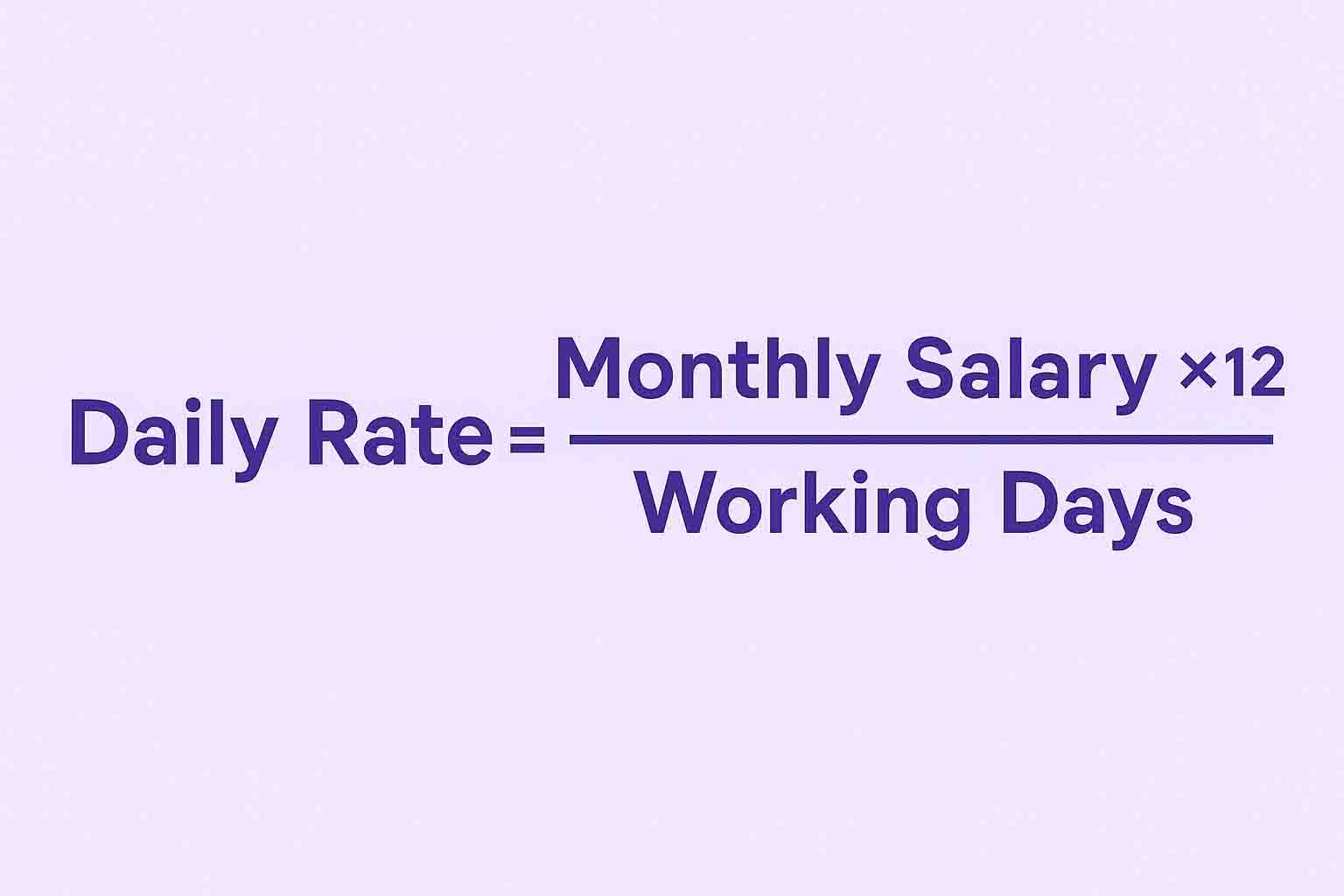
Daily Rate = (Monthly Salary × 12) ÷ Annual Factor
Common Annual Factors
| Work Schedule | Common Annual Factor |
|---|---|
| Monthly Paid (Calendar Days Basis) | 365 |
| Monday to Friday | 260 or 261 |
| Monday to Friday + Half-Day Saturday | 286 or 287 |
| Monday to Saturday | 312 |
Table of Contents
- Why the Correct Daily Rate Matters
- Standard Formula for Daily Rate
- Common Payroll Factors Used in the Philippines
- When Should You Use 365?
- Example: Five-Day Workweek
- Example: Six-Day Workweek
- Compressed Workweek Schedules
- Where Is the Daily Rate Used?
- Frequently Asked Questions
- Payroll Accuracy Builds Trust
Why the Correct Daily Rate Matters
1. Accurate Deductions for Absences, Tardiness, and Undertime
When employees incur absences, tardiness, or undertime, payroll deductions are usually based on the employee’s daily or hourly rate. Using the wrong daily rate may result in over-deducting or under-deducting employees.
2. Proper Tax Computation
Minimum Wage Earners (MWEs) in the Philippines are generally exempt from withholding tax on their basic pay. To determine whether an employee qualifies as a minimum wage earner, employers must first establish the employee’s correct daily rate.
3. Correct Overtime Computation
Overtime pay is computed based on the employee’s hourly rate, which is derived from the daily rate. An incorrect daily rate means overtime, holiday pay, night differential, and rest day computations will also be incorrect.
Standard Formula for Daily Rate
A commonly used formula is:
Daily Rate = (Monthly Salary × 12) ÷ Annual Factor
The annual factor represents the total number of paid or working days in a year based on the employee’s work schedule and company policy.
Common Payroll Factors Used in the Philippines
The annual factor varies depending on the employee’s work schedule.
| Work Schedule | Common Annual Factor |
|---|---|
| Monthly Paid (Calendar Days Basis) | 365 |
| Monday to Friday | 260 or 261 |
| Monday to Friday + Half-Day Saturday | 286 or 287 |
| Monday to Saturday | 312 |
How These Factors Are Derived
| Work Schedule | Computation | Factor |
|---|---|---|
| Monday to Friday | 5 days × 52 weeks | 260 |
| Monday to Saturday | 6 days × 52 weeks | 312 |
| Monday to Friday + Half-Day Saturday | 5.5 days × 52 weeks | 286 |
| Calendar Days Basis | All calendar days in a year | 365 |
Some companies use 261 instead of 260 and 287 instead of 286 based on long-standing payroll practice, company policy, and the fact that a calendar year is not exactly 52 weeks. Since a normal year contains 365 days and a leap year contains 366 days, there may be additional working days beyond the simple 52-week computation depending on how the calendar falls.
As a result, it is common to encounter annual factors of 260 or 261 for a five-day workweek and 286 or 287 for a five-and-a-half-day workweek. Employers should consistently apply the factor specified in their payroll policies and employment agreements.
When Should You Use 365?
Many companies use a 365-day factor for monthly-paid employees because monthly-paid employees are generally paid for all days of the month, including regular rest days, regular holidays, and certain special days as provided under applicable labor rules and company policies.
This approach is commonly used in payroll practice and aligns with the concept of monthly-paid employees discussed in the DOLE Handbook.
Example: Five-Day Workweek
Monthly Salary: ₱16,000
Annual Factor: 261
Daily Rate = (₱16,000 × 12) ÷ 261
Daily Rate = ₱735.63
This daily rate becomes one basis for determining whether the employee qualifies as a minimum wage earner.
For example, if the applicable regional minimum wage is ₱695 per day, a daily rate of ₱735.63 is above the minimum wage threshold.
Example: Six-Day Workweek
Using the same monthly salary:
Monthly Salary: ₱16,000
Annual Factor: 312
Daily Rate = (₱16,000 × 12) ÷ 312
Daily Rate = ₱615.38
In this example, the daily rate is below the NCR minimum wage rate. Employers should verify whether the employee’s compensation complies with applicable wage orders and labor regulations.
Compressed Workweek Schedules
Some employers implement a compressed workweek arrangement where employees work fewer days per week but longer hours per day.
| Schedule | Hours Per Day | Days Worked Per Week |
|---|---|---|
| Regular Schedule | 8 | 5 |
| Compressed Workweek | 10 | 4 |
| Compressed Workweek | 12 | 4 |
For payroll purposes, one practical approach is to determine the employee’s equivalent workdays based on the total required working hours per week.
Equivalent Workdays Per Week = Required Working Hours Per Week ÷ 8
The equivalent workdays can then be multiplied by 52 weeks to determine the annual factor.
| Required Weekly Hours | Equivalent Workdays | Common Annual Factor |
|---|---|---|
| 40 | 5 | 260 or 261 |
| 44 | 5.5 | 286 or 287 |
| 48 | 6 | 312 |
For example, an employee who works four 10-hour days per week works a total of 40 hours per week. Since 40 ÷ 8 = 5 equivalent workdays, the annual factor would typically be 260 or 261.
Similarly, an employee who works four 12-hour days per week works a total of 48 hours per week. Since 48 ÷ 8 = 6 equivalent workdays, the annual factor would typically be 312.
This method helps maintain consistency when computing daily rates, hourly rates, overtime pay, leave conversions, and other payroll-related calculations regardless of how the work schedule is structured.
Where Is the Daily Rate Used?
The daily rate serves as the foundation for many payroll computations, including:
- Absence deductions
- Tardiness and undertime deductions
- Overtime pay
- Night differential pay
- Holiday pay
- Rest day pay
- Service Incentive Leave (SIL) conversions
- Unused leave conversions
- Separation pay computations
- Computation of hourly rates
Because so many payroll computations depend on the daily rate, even a small error can create significant payroll discrepancies over time.
Frequently Asked Questions
What is the formula for computing daily rate in the Philippines?
The commonly used formula is:
Daily Rate = (Monthly Salary × 12) ÷ Annual Factor
The annual factor depends on the employee’s work schedule and company payroll policy.
How do I convert monthly salary to daily rate?
Multiply the monthly salary by 12 and divide the result by the applicable annual factor.
Example:
Monthly Salary = ₱20,000
Annual Factor = 261
Daily Rate = (₱20,000 × 12) ÷ 261
Daily Rate = ₱919.54
Should I use 260, 261, or 365 as the annual factor?
It depends on the employee’s work schedule and your company’s payroll policy.
- Five-day workweeks commonly use 260 or 261.
- Five-and-a-half-day workweeks commonly use 286 or 287.
- Six-day workweeks commonly use 312.
- Monthly-paid employees are often computed using a 365-day factor.
What annual factor should I use for a six-day workweek?
A six-day workweek typically uses an annual factor of 312, which is derived from:
6 working days × 52 weeks = 312
Why do some companies use 261 instead of 260?
Some companies use 261 instead of 260 based on company policy, payroll practice, and the fact that a calendar year is not exactly 52 weeks.
Why do some companies use 287 instead of 286?
Similar to the 261 factor, some employers use 287 instead of 286 for employees who work Monday to Friday plus a half-day on Saturday.
How do I compute the daily rate for employees on a compressed workweek?
Determine the equivalent workdays based on required weekly hours.
Equivalent Workdays Per Week = Required Weekly Hours ÷ 8
The equivalent workdays can then be multiplied by 52 weeks to determine the annual factor.
Why is the daily rate important in payroll?
The daily rate is used to compute absence deductions, tardiness, undertime, overtime pay, holiday pay, night differential, leave conversions, hourly rates, and minimum wage compliance.
Can the daily rate affect withholding tax?
Yes. The daily rate may be used as one basis in determining whether an employee qualifies as a Minimum Wage Earner (MWE). Employees who qualify as MWEs generally enjoy certain tax exemptions under Philippine tax regulations.
Payroll Accuracy Builds Trust
Employees rely on accurate and timely payroll. When salary computations are transparent and consistent, it builds employee trust and reduces payroll disputes.
If you want to improve payroll accuracy while reducing the time spent on payroll processing, consider using MPM Payroll. MPM Payroll automatically computes daily rates, hourly rates, overtime, government contributions, taxes, holidays, leave conversions, and other payroll transactions based on your company’s payroll policies, helping you save time while minimizing payroll errors.

BHONG says
can you gave me a salary distribution based on DOLE for a roving guard with vehicle
teresa magtibay says
mam my i know how is the proper computation of salary .
sample the one month salary is 8000 how much her daily rate and if shes late for 10 min. how much i deduct it.
tnx
Roma says
How will I know how much is my tax in every cut off? if example i’m earning 17,000 a month? thank you.
Jayl Rosario says
if an employee only works 10 months a year, shall i use 10 as “number of months in a year” or still 12? thank you very much.
jeff says
how to compute the withholding tax of under minimum wage and not under minimum wage? thanks
Pacita says
Hi,
What if the employee is working in a compressed week, he is working monday to friday for a total 48 hours. His daily rate is computed monthly rate x 12 / 31. He started sept 15 and our semi monthly payroll for 2nd half cut-off is sept 11-25, how many days we have to deduct from his gross pay? Is it two day for sept 11-12 or including Sept 13 for a total of 3 days. Thanks.
Jaycee says
I am a new sole proprietor and I want to hire an assistant for P350 per day (net of sss, Philhealth and Pag-ibig benefits) which I can only afford to pay as of now… how should his monthly payslip computed? and how much should i remit to SSS, PH & Pag-ibig?
Thank you.
nelmarie java says
a health personnel rendered his service 48 hours a week. how much will he get in a week?
Akash Nimodiya says
Is monthly wage rate calculated in Philippines ? If yes, can you send me that document as attachment to mail
Dj Marmolejo says
In 10,500 how much my daily income. Except sundays because its my dayoff.
Jerick Allan Dimaano says
Hello good day. I’m Jerick, web developer and working with a small company. Our salary are given every 15th and last day of the month. Saturdays and Sundays are our day off. We have a monthly fixed salary like even if we only work for 10 days or 11 days in a certain cutoff period we received the same amount every time. Our cutoff periods are 26-10 given on 15th and 11-25 given on the last day of the month.
Our Boss wants to change the payroll dates from every 15th and last day of the month to every 7th and 22nd day of the month and also the cutoff period from 26-10 to 1-15 and 11-25 to 16-last day of month. He said the reason for the change is to make it easier for them to do the book keeping, something like that.
So to make the adjustments happen, our company will do like this, knowing that today is December 11, 2014 when I sent this letter.
-On Monday December 15, 2014 the company will give us our salary from November 26 to 30 2014 and they said it is computed for 3 days only, because Nov 29 and 30 are saturday and sunday.
-Then on December 22, 2014, we will get our salary for the period of December 1-15, 2014.
My question is, Is it right that we will only receive 3 days amount for Nov 26 – 30?
Marja Echano says
Hi, tanong ko lng regarding sa monthly fixed rate. pag nakuha ko n yung daily rate assuming na 10,000 a month tpos we are working for mondays to saturdays , including special non-working holidays. yung daily rate n nakuha ko yun n gagamitin or kinuha lng daily rate for the deductions of absences and overtime?
10000 x 12 / 303= daily rate?
Tama po ba? kasi kasama yung special non-working nmin.
Thank you.
robert maglaque says
good day po. tanong ko lang po dito po company namin ang computation ng salary dati at (monthly salary÷ 25.25) ngayon po (monthly salary÷26) naguguluhan po ako sa binigay niyong fomula. monday to saturday po pasok ko. salamat and god bless
lester tan says
what computation if it falls in the month of february…
Jonathan Santiago says
panu naman po yung daily rate! kapag meron pong holiday and special hoidays po.
arnel D. Red says
Ako ay security guard,tanong ko lang po kung tama sang binibigay na salary mula sa agency ko.ang contracts po ng company’s sa agency nmim ay 16,000,ang binibigay lang po ng agency ko na salary ko ay 10,000 don pa po binabawas an sss .magkano po ba dapat any tamang salary ko mula as agency ko. SG.red po.type po and godbless you all,ASA po ako satullong nyo.
Sheena says
Hi, ask ko lang kung tama ba na kahit ang basis ng wage computation namin eh sa factor 261 days (daily wage earner) kapag hindi pumasok ang employee on special non working holiday eh hindi paid. Pero based on the salary above minimum earner ang employee. Diba applicable lang ang “no work, no pay” sa minimum wage earner? ngkataon lang na ang basis ng computation ng salary eh sa 261 days factor?. I confused and i need a valid reason and link na maiiexplain ko sa supervisor. It’s unfair kasi sa employee na hindi bayad ng regular day sa SP Non working kahit above minimum/ fixed rate salary ang employee.
Lia B. says
what if an employee is a monthly paid employee and her salary is 14000, working 5 days a week. does it mean that if i compute for her daily rate and it falls below the minimum daily rate then i have to adjust her monthly salary ?
neslie says
Hi..ung father ko ndi fixed ang salary kasi per byahe sya..1600 per byahe kasi trucking driver sya..married pero unemployed ang mother ko..exempted ba sya o taxable?highest na byahe nya 8 lowest is 2 pero ang deduction ng company more than 1k..tama ba un?thanks
carlo taladtad says
sir’/mam’ ask ko lng po diba dun sa sample nyu kung panu malalaman ung daily rate ng employees” is 10000x(days of work)/? ?? san nyu po n a kuha ung divider?? answer plzz.. asap”