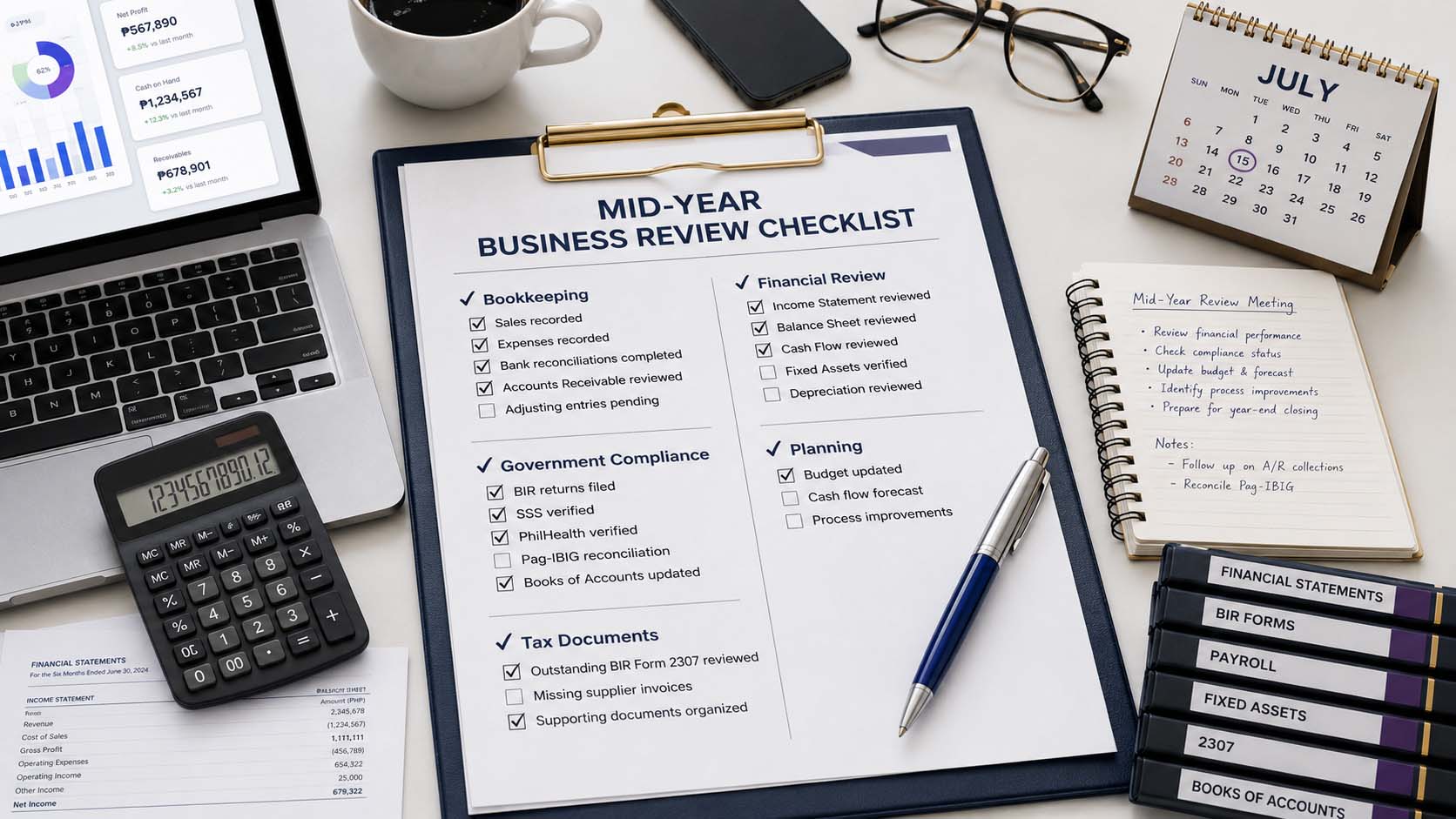
The first half of the year is already behind us. Before getting busy with the final months of the year, now is an ideal time to step back and evaluate how your business is performing.
A mid-year business review helps you understand where your business stands today, identify issues while there is still time to address them, and make better decisions for the remainder of the year.
After working with Philippine SMEs since 2011, we’ve found that businesses that regularly review their financial records, government compliance, and operations in the middle of the year are generally better prepared for year-end than those who wait until December.
Whether your business has been growing steadily or has experienced a quieter period, a mid-year review gives you an opportunity to strengthen your business before the year comes to a close.
Why Conduct a Mid-Year Business Review?
Running a business often means focusing on customers, employees, operations, and daily challenges. Administrative work such as bookkeeping, reviewing financial statements, or checking government compliance is frequently postponed until it becomes urgent.
The middle of the year is a good opportunity to pause and ask an important question:
If I continue operating exactly the same way for the rest of the year, where will my business likely end up?
A mid-year review helps answer that question using facts instead of assumptions.
More importantly, it gives you enough time to correct problems before they become year-end issues.
1. Are Your Financial Records Complete and Accurate?
Before making business decisions, make sure your accounting records are complete.
We often encounter businesses that are months behind in bookkeeping. Some have missing expense records, unreconciled bank accounts, or incomplete supporting documents. Without complete records, financial reports become unreliable and business decisions become difficult.
Review whether you have:
- Recorded all sales and collections.
- Recorded all purchases, expenses, and payments.
- Reconciled your cash and bank balances.
- Updated Accounts Receivable and Accounts Payable.
- Recorded necessary adjusting entries.
- Organized invoices, receipts, and supporting documents.
Good bookkeeping is not simply for tax compliance – it provides reliable information for making better business decisions.
2. Are You Up to Date With Government Compliance?
Government compliance is another area that business owners commonly delegate to accountants or bookkeepers. While this is practical, responsibility ultimately remains with the business owner.
One of the more common situations we encounter is that businesses only discover missing tax filings, unpaid contributions, or incomplete records after receiving a notice from a government agency or during an audit. By then, correcting the issue is often more costly and stressful.
Use this opportunity to verify that your compliance records are complete.
Review your:
- BIR tax returns and payments.
- SSS contributions and reports.
- PhilHealth contributions.
- Pag-IBIG contributions.
- Business permits and registrations.
- Proof of filing, payment, and official acknowledgements.
Even if someone else prepares your compliance requirements, requesting copies of filing confirmations and payment acknowledgements gives you better visibility over your business.
Verify That Contributions Have Actually Been Posted
Making a payment is only one part of compliance. It is equally important to verify that the payment has been successfully posted in the records of the corresponding government agency.
Log in to the employer portals of SSS, PhilHealth, and Pag-IBIG and review the first six months of the year.
Confirm that:
- All employee contributions have been posted.
- Payment amounts match your payroll records.
- There are no missing or unmatched transactions.
Mid-year is an ideal time to reconcile discrepancies because accounting and payroll teams are generally less occupied with annual compliance deadlines.
Resolving posting issues early helps avoid employee benefit concerns, delays in claims, and unnecessary reconciliation work during year-end.
Review Your Books of Accounts
If your business maintains manual books of accounts, check whether they have been updated through the first six months of the year.
Many businesses record transactions in their accounting software or spreadsheets but postpone updating their registered books of accounts. As time passes, catching up becomes more difficult and increases the risk of missing or inaccurate entries.
Review whether:
- Your General Journal and General Ledger are updated.
- Cash Receipts and Cash Disbursements Books are current, where applicable.
- Subsidiary ledgers agree with your accounting records.
- Supporting documents are complete and properly filed.
Keeping your books of accounts current makes year-end closing easier and ensures your records are readily available if requested during a BIR audit or examination.
3. Have You Collected Important Tax Documents?
One of the most overlooked areas during a mid-year review is the collection of tax documents from customers and suppliers.
Many businesses only begin following up on these documents near year-end, when accounting books are about to be closed. By then, it may be more difficult to obtain missing documents or resolve discrepancies.
Reviewing these items in the middle of the year gives everyone enough time to complete the necessary documentation before year-end.
Follow Up on Outstanding BIR Form 2307
If your customers withheld Expanded Withholding Tax (EWT) from your sales, make sure you have already collected the corresponding signed BIR Form 2307 (Certificate of Creditable Tax Withheld at Source).
The signed Form 2307 serves as supporting documentation for claiming creditable withholding taxes. If significant certificates remain outstanding, follow up with your customers as early as possible rather than waiting until year-end.
Prepare a list of outstanding certificates and regularly monitor follow-ups.
Review Missing Supplier Invoices and Supporting Documents
Review purchases and expenses where supporting documents are still incomplete.
Pay particular attention to material transactions that could significantly affect your financial statements or tax reporting.
Examples include:
- Supplier invoices not yet received.
- Billing statements.
- Contracts.
- Proofs of payment.
- Bank statements.
- Supporting schedules.
Obtaining these documents while transactions are still recent is considerably easier than reconstructing them during year-end.
4. What Do Your Financial Statements Tell You?
Once your bookkeeping is complete, your financial statements become one of your most valuable management tools.
Ask questions such as:
- Is revenue growing or slowing down?
- Which products or services generate the highest profit?
- Which customers contribute the most revenue?
- Which expenses increased significantly?
- Are profit margins improving or declining?
- Is cash flow healthy?
- Are customers taking longer to pay?
- Are there products, services, or customers that consistently lose money?
Your:
- Income Statement measures profitability.
- Balance Sheet shows your financial position.
- Cash Flow statement shows whether your business is generating enough cash to sustain operations.
Together, these reports help identify trends and opportunities before they become problems.
Review Your Fixed Assets and Depreciation
Fixed asset transactions occur less frequently than daily expenses, making them easy to overlook.
Review whether:
- Major equipment purchases were correctly recorded as fixed assets instead of ordinary expenses.
- Newly acquired assets were added to your fixed asset register.
- Depreciation has been recorded for all depreciable assets.
- Assets that were sold or disposed of have been removed or properly adjusted.
- Your fixed asset register agrees with your accounting records.
Incorrect capitalization or missing depreciation can significantly affect both your financial statements and taxable income. Identifying these issues in the middle of the year gives you sufficient time to make corrections before year-end.
5. What Should You Change for the Second Half of the Year?
One advantage of conducting a review in the middle of the year is that you now have six months of actual business data.
Review and update your:
- Sales targets.
- Expense budget.
- Cash flow forecast.
- Hiring plans.
- Inventory purchases.
- Capital expenditures.
- Marketing activities.
Ask yourself:
- Are we spending money in the right places?
- Do we need to adjust pricing?
- Are there unnecessary expenses that can be reduced?
- Do we have enough working capital?
- Are we prepared for increased demand during the final quarter?
6. Can Routine Tasks Be Automated?
Another worthwhile question is whether your team spends too much time on repetitive administrative work.
Many businesses still manually prepare payroll, tax forms, government reports, and financial reports every month.
Automation can reduce repetitive work, improve consistency, and free your team to focus on serving customers and growing the business.
Technology does not replace good accounting practices—it helps you perform them more efficiently.
Common Issues We Frequently See During Mid-Year Reviews
After working with Philippine SMEs since 2011, these are some of the most common issues we encounter during mid-year business reviews:
- Bookkeeping that is several months behind.
- Bank accounts that have not been reconciled.
- Registered books of accounts that have not been updated for several months.
- Differences between the books of accounts and the accounting records.
- Outstanding signed BIR Form 2307 certificates that have not yet been collected.
- Missing supplier invoices and supporting documents.
- SSS, PhilHealth, or Pag-IBIG payments that were made but have not yet been posted in the government agency’s records.
- Payroll records that do not reconcile with government contribution records.
- Significant equipment purchases recorded as ordinary expenses instead of fixed assets.
- Fixed assets that were recorded correctly but were never depreciated.
- New assets that were never added to the fixed asset register.
- Assets that have been disposed of but continue to appear in the accounting records.
- Tax returns that were filed but proof of filing or payment cannot be located.
- Financial statements that have not been reviewed since the previous year.
- Business owners who know their sales but cannot accurately determine profitability.
- Cash flow problems that could have been identified much earlier through regular financial reviews.
Fortunately, most of these issues can still be corrected before year-end when they are identified early.
A mid-year business review is more than an accounting exercise.
It is an opportunity to pause, evaluate where your business stands today, and make informed decisions while there is still enough time to improve your results before the year ends.
By reviewing your bookkeeping, compliance, books of accounts, supporting documents, financial statements, fixed assets, and future plans, you gain greater visibility into your business and reduce the likelihood of unpleasant surprises during year-end closing.
The earlier you identify issues, the easier—and often less expensive—they are to resolve.
Simplify Your Mid-Year Review with the Right Tools
Maintaining accurate financial records becomes much easier when routine tasks are organized and automated.
MPM Accounting helps businesses:
- Record accounting transactions.
- Maintain fixed asset records and compute depreciation.
- Generate financial statements and management reports.
- Automate BIR tax computations, forms, and attachments.
- Track outstanding BIR Form 2307 certificates.
- Organize accounting records and supporting documents.
- Monitor government compliance in one system.
For businesses with employees, MPM Payroll helps automate:
- Payroll computation.
- Withholding tax computation.
- SSS, PhilHealth, and Pag-IBIG contributions.
- Government reports.
- Employee self-service and payroll distribution.
Whether you use MPM or another accounting solution, the important thing is having timely, accurate, and reliable financial information that supports better business decisions throughout the year.

Leave a Reply