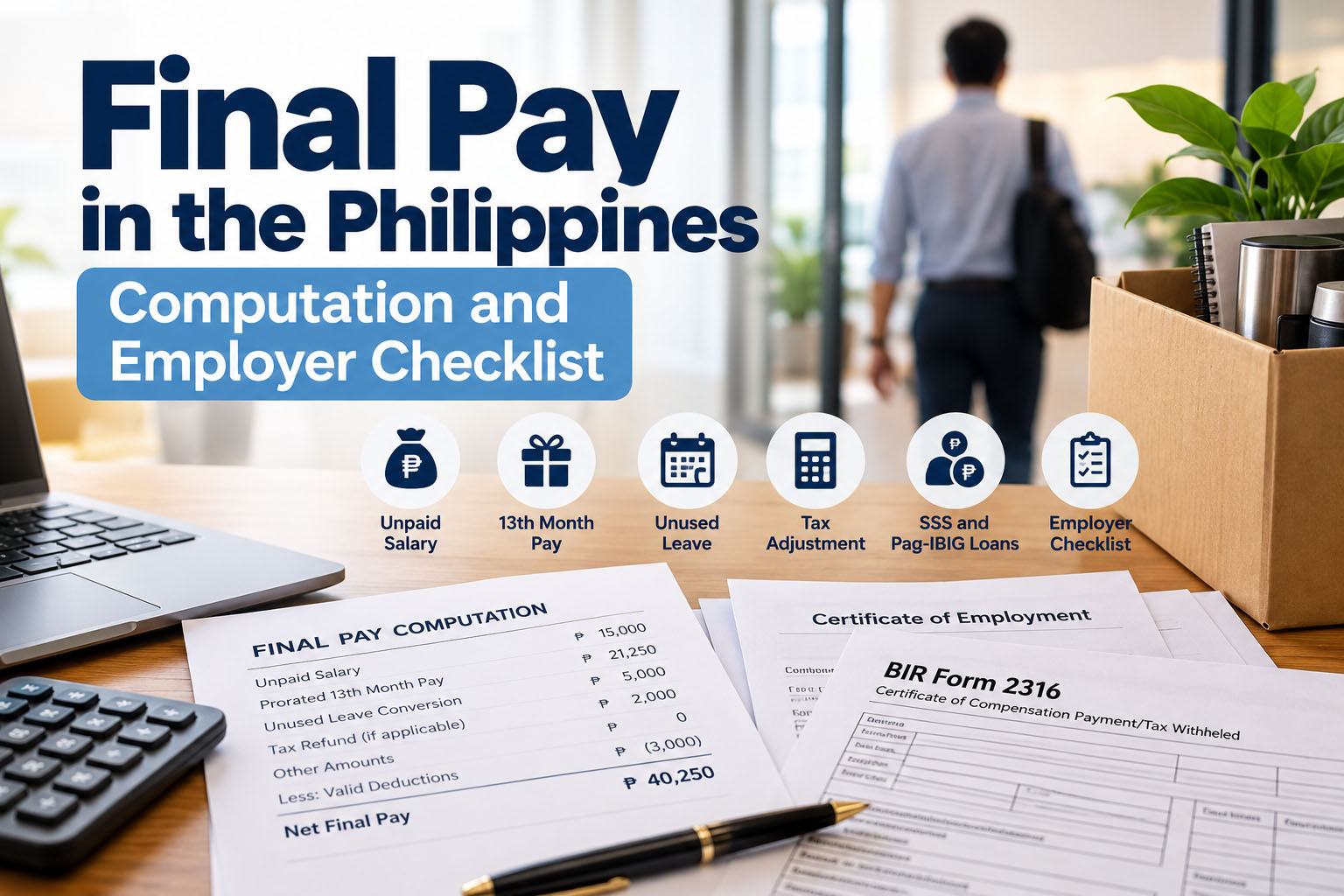
When an employee resigns, retires, or is terminated, the employer still has several payroll obligations to complete. One of the most important is the computation and release of the employee’s final pay.
Final pay is more than simply paying an employee for the last few days they worked. Depending on the circumstances, it can include unpaid salary, prorated 13th month pay, unused leave credits, tax adjustments, separation pay, and other amounts due to the employee.
For employers, calculating final pay correctly is important not only for payroll accuracy but also for compliance with Philippine labor and tax regulations.
This guide explains what should be included in final pay, how to calculate common components, when payment must be released, and what employers should check before completing an employee’s offboarding process.
What Is Final Pay?
Final pay refers to the total amount of wages and benefits due to an employee upon separation from employment, regardless of whether the employee resigned, retired, was terminated, or separated for another reason.
Under Department of Labor and Employment (DOLE) Labor Advisory No. 06, Series of 2020, final pay may include:
- Unpaid salary or wages
- Prorated 13th month pay
- Cash conversion of unused Service Incentive Leave (SIL)
- Cash conversion of unused vacation, sick, or other leave benefits, when applicable
- Separation pay, when applicable
- Retirement pay, when applicable
- Income tax refunds or adjustments
- Other compensation or benefits due under company policy, employment agreements, or a Collective Bargaining Agreement (CBA)
Not every employee is entitled to all these components. The actual computation depends on the employee’s compensation, benefits, reason for separation, applicable company policies, and outstanding obligations.
DOLE Labor Advisory No. 06, Series of 2020 also provides that final pay should generally be released within 30 days from the employee’s date of separation or termination, unless a more favorable company policy, individual agreement, or CBA applies.
DOLE reiterated this requirement in January 2026.
Final Pay vs. Last Pay vs. Back Pay: What’s the Difference?
The terms final pay, last pay, and back pay are frequently used interchangeably in Philippine workplaces.
DOLE itself sometimes uses these terms to refer to the amounts due upon separation. However, distinguishing them can be useful when explaining payroll computations to employees.
Final Pay
Final pay is the employee’s complete financial settlement upon separation.
It includes the employee’s remaining salary together with other applicable amounts, such as prorated 13th month pay, convertible leave credits, tax adjustments, separation pay, and other benefits.
Last Pay or Last Salary
In ordinary payroll usage, last pay may refer specifically to the employee’s salary for their final payroll period.
For example, an employee whose last working day is September 10 may still have salary due for the days worked from September 1 to September 10.
That salary forms part of the employee’s final pay, but it is not necessarily the entire final-pay computation.
Back Pay and Backwages
The term back pay is sometimes used informally as another name for final pay.
However, employers should distinguish this from backwages, which has a more specific meaning under Philippine labor law.
Backwages generally arise in labor disputes such as illegal dismissal. Under Article 294 of the Labor Code, an unjustly dismissed employee may be entitled to full backwages, including allowances and other benefits or their monetary equivalent, for the applicable period.
For ordinary resignations and employee separations, final pay is generally the clearer term to use.
What Should Be Included in Final Pay?
There is no single final-pay formula that applies to every employee.
Instead, employers must identify the earnings, benefits, tax adjustments, and valid deductions applicable to the employee as of their separation date.
1. Unpaid Salary or Wages
The employee must still be paid for work already performed but not yet included in a previous payroll.
Depending on the employee’s circumstances, this may include:
- Regular salary or wages
- Overtime pay
- Holiday pay
- Rest day premium
- Night shift differential
- Commissions
- Other unpaid compensation
Normal payroll computation rules continue to apply.
For example, if an employee resigns effective September 10 and the last payroll covered only up to August 31, the employer must still compute the salary or wages due for September 1 to September 10.
For monthly-paid employees, the applicable daily-rate computation should follow the employee’s compensation arrangement and the company’s legally compliant payroll methodology.
For daily-paid employees, the computation should generally be based on the applicable paid days or hours and other earned compensation.
Employers should also verify whether any absences, undertime, overtime, or holiday work during the final payroll period have been properly recorded.
2. Prorated 13th Month Pay
Employees covered by the 13th month pay requirement remain entitled to proportionate 13th month pay when they resign or their employment ends before the usual payment date.
Under Presidential Decree No. 851 and the Revised Guidelines on the Implementation of the 13th Month Pay Law, the minimum 13th month pay is generally computed as:
13th Month Pay = Total Basic Salary Earned During the Calendar Year ÷ 12
The Revised Guidelines expressly recognize the entitlement of employees who resign or whose services are terminated before the normal payment date.
Example: Prorated 13th Month Pay
Suppose an employee earned:
| Period | Basic salary earned |
|---|---|
| January to August | ₱240,000 |
| September, before separation | ₱15,000 |
| Total basic salary earned | ₱255,000 |
The prorated 13th month pay would be:
₱255,000 ÷ 12 = ₱21,250
If the employee already received part of their 13th month pay during the year, the employer should deduct the amount previously paid when determining the remaining balance.
It is also important to use the employee’s actual basic salary earned, rather than simply multiplying their current monthly salary by the number of months employed.
For example, an employee who received a salary increase during the year should have their 13th month pay computed using the applicable basic salary earned before and after the increase.
Likewise, unpaid absences or other circumstances affecting basic salary earned may affect the computation.
Legal references: Presidential Decree No. 851 and the Revised Guidelines on the Implementation of the 13th Month Pay Law.
For a more complete guide on 13th month pay, we recommend or How to compute 13th month pay article.
3. Unused Leave Credits
Unused leave credits may also form part of final pay when they are convertible to cash.
Under Article 95 of the Labor Code, covered employees who have rendered at least one year of service are generally entitled to five days of Service Incentive Leave (SIL) annually, subject to statutory exclusions.
Unused statutory SIL is commutable to its monetary equivalent.
Where an employee has accumulated unused statutory SIL credits, the applicable accrued balance may remain payable upon resignation or separation.
However, employers should distinguish statutory SIL from additional leave benefits provided by the company.
Many employers offer vacation leave, sick leave, or other leave benefits beyond the statutory minimum. Whether these additional leave credits are convertible to cash may depend on:
- Employment contracts
- Employee handbooks
- Established company policies
- Collective Bargaining Agreements
- Established company practices
For example, a company may provide 15 days of vacation leave annually but allow cash conversion of only five unused days upon resignation, provided the arrangement complies with applicable statutory entitlements.
Employers should also remember that certain employees are excluded from statutory SIL coverage, including those already enjoying qualifying vacation leave benefits of at least five days.
Important: Employers should not automatically assume that every unused leave balance is payable or forfeited. The statutory entitlement and the company’s applicable leave policy should be reviewed before completing the computation.
Legal reference: Article 95 of the Labor Code and its Implementing Rules.
To read more about this subject, we recommend our article Unused Leave Credit Conversion.
4. Separation Pay, If Applicable
Final pay and separation pay are not the same thing.
Final pay is the complete financial settlement owed to an employee. Separation pay is only one possible component of that settlement.
An employee who voluntarily resigns is generally not automatically entitled to separation pay, unless it is provided under an employment contract, company policy, established practice, CBA, or another applicable arrangement.
However, separation pay may be legally required for certain employer-initiated separations.
Under Article 298 of the Labor Code, different minimum separation-pay formulas apply depending on the authorized cause of termination.
For example:
| Reason for separation | General statutory minimum |
|---|---|
| Redundancy | One month’s pay or one month’s pay for every year of service, whichever is higher |
| Installation of labor-saving devices | One month’s pay or one month’s pay for every year of service, whichever is higher |
| Retrenchment to prevent losses | One month’s pay or one-half month’s pay for every year of service, whichever is higher |
| Closure or cessation of operations not due to serious business losses | One month’s pay or one-half month’s pay for every year of service, whichever is higher |
Under the applicable statutory formulas, a fraction of at least six months is generally considered one whole year.
Termination due to disease is governed separately by Article 299 of the Labor Code, which also provides for separation pay under the conditions stated in that article.
The employer should determine the correct legal basis and formula before including separation pay in the employee’s final-pay computation.
Special circumstances, including closures due to serious business losses, may affect whether statutory separation pay is required.
Legal references: Articles 298 and 299 of the Labor Code of the Philippines, as amended.
5. Retirement Pay, If Applicable
If the employee is retiring rather than simply resigning or being terminated, retirement benefits may also need to be included.
Under Republic Act No. 7641, which amended the Labor Code’s retirement provisions, covered employees may qualify for statutory retirement pay subject to the applicable age, service, and coverage requirements.
The statutory minimum retirement pay is generally based on at least one-half month’s salary for every year of service, with the statutory definition of one-half month’s salary including specified additional components.
However, the actual retirement benefit may depend on whether the employee is covered by:
- Statutory retirement provisions
- A company retirement plan
- An employment agreement
- A CBA
Employers should apply the applicable retirement arrangement and ensure that employees receive at least the benefits required by law.
Legal references: Republic Act No. 7641 and Article 302 of the Labor Code, as amended.
6. Tax Adjustment or Tax Refund
Final payroll can also trigger an important income tax adjustment.
Under BIR Revenue Regulations No. 11-2018, an employer must perform the applicable annualized withholding-tax computation when an employee separates before December.
The calculation considers the employee’s taxable compensation for the calendar year, including taxable compensation from previous employment during the same year, when applicable and supported by the employee’s records.
The employer then determines the applicable income tax and compares it against taxes already withheld.
This may result in either:
- Additional withholding tax, if the amount previously withheld is insufficient; or
- A tax refund, if the amount previously withheld exceeds the applicable tax due.
For example, an employee who resigns in September may have already paid more withholding tax than their annualized taxable compensation requires.
In that situation, the employer may need to refund the excess withholding as part of the final payroll computation.
However, employers should not assume that every separating employee will receive a tax refund. The result depends on the employee’s actual taxable compensation, applicable exemptions or exclusions, and taxes already withheld.
To understand this better, we recommend to read about Payroll Tax Annualization.
What About Separation Pay?
The tax treatment of separation pay depends on the reason and circumstances of the employee’s separation.
Under Section 32(B)(6)(b) of the National Internal Revenue Code, as amended, certain amounts received because of separation due to death, sickness, physical disability, or other causes beyond the employee’s control may qualify for exclusion from gross income.
Qualifying benefits arising from circumstances such as redundancy or retrenchment may fall within this provision, subject to the applicable legal requirements.
Employers should therefore determine the nature and legal basis of separation benefits before deciding whether they are taxable.
Legal references: BIR Revenue Regulations No. 11-2018 and Section 32(B)(6)(b) of the National Internal Revenue Code, as amended.
Read BIR Revenue Regulations No. 11-2018
7. Other Amounts Due to the Employee
Depending on the employee’s compensation arrangement, other outstanding amounts may also need to be included in final pay.
These may include:
- Earned commissions
- Performance incentives
- Approved reimbursements
- Unpaid allowances
- Bonuses already earned under company policy
- Benefits under an employment agreement or CBA
- Other unpaid compensation
Employers should review the employee’s actual records rather than relying only on the regular payroll configuration.
For example, a sales employee may still have earned commissions that were not included in their last regular payroll.
Whether these amounts are already payable will depend on the applicable commission agreement or company policy.
Can Employers Deduct Employee Accountabilities from Final Pay?
Final pay is often processed together with the company’s employee clearance procedure.
The employee may still have outstanding accountabilities such as:
- Company-issued equipment or property
- Cash advances
- Employee loans
- Unliquidated expenses
- Other documented obligations
However, employers should not assume that every outstanding accountability can automatically be deducted from final pay.
Articles 113 and 114 of the Labor Code, together with applicable implementing rules, regulate deductions from wages and deductions relating to loss or damage.
Employers should ensure that deductions have a valid legal, contractual, or authorized basis.
For example, an employer should not simply assign an arbitrary amount to damaged company equipment and deduct it from the employee’s final salary without establishing the applicable basis and complying with relevant requirements.
It is good practice to document employee accountabilities early during the clearance process so that any valid deductions can be identified and resolved before the final-pay deadline.
What Happens to Outstanding SSS and Pag-IBIG Loans?
Employers should also check whether a separating employee has outstanding government loans.
These obligations require particular attention because regular payroll deductions will stop once the employee separates.
Outstanding SSS Salary Loans
Under SSS Circular No. 2025-004 – Guidelines of the SSS Salary Loan Program, an employer is required to deduct the outstanding salary-loan balance from compensation or benefits due to a separating employee and remit the amount to SSS.
This applies whether the employee’s separation is voluntary or involuntary.
If the employee’s compensation and benefits are insufficient to fully settle the outstanding loan, the employer must report the employee’s effective separation date and remaining unpaid loan balance through the SSS Loan Collection List (LCL).
The report must be submitted no later than the last day of the month immediately following the month of separation.
Employers should therefore verify the employee’s outstanding SSS Salary Loan balance before finalizing the payroll computation.
These rules concern the SSS Salary Loan Program. Other SSS loan programs may have separate requirements.
Reference: SSS Salary Loan Program and employer responsibilities
Outstanding Pag-IBIG Loans
Pag-IBIG Multi-Purpose Loans are handled differently.
The official Pag-IBIG Multi-Purpose Loan Application Form (HQP-SLF-065, V08) contains an optional Authority to Deduct.
When executed by the employee, this authorization permits the employer to deduct the outstanding Multi-Purpose Loan balance from retirement or separation benefits under the terms of the authorization.
Employers should therefore review the employee’s applicable loan records and authorizations before making deductions.
Unlike the SSS Salary Loan rules discussed above, employers should not automatically assume that every outstanding Pag-IBIG loan requires full deduction from final pay or the execution of a separate loan undertaking.
If the employee has an unpaid loan balance after separation, the employee should coordinate with Pag-IBIG Fund regarding the applicable repayment arrangements.
Reference: Pag-IBIG Multi-Purpose Loan Application Form, HQP-SLF-065, V08
What Is a Quitclaim and Is It Required for Final Pay?
Some employers ask separating employees to sign a Release, Waiver and Quitclaim when receiving their final pay.
A quitclaim generally documents the employee’s acknowledgment of a settlement and identifies the employment claims covered by the agreement.
However, DOLE Labor Advisory No. 06, Series of 2020 does not prescribe signing a quitclaim as a requirement for the release of final pay.
Employers may use a properly prepared quitclaim as part of their offboarding documentation, but it should not be treated as a substitute for correctly computing and paying everything legally due to the employee.
The Supreme Court has also emphasized that quitclaims are not automatically valid merely because an employee signed them.
In Rodriguez and Rama v. San Roque Metals, Inc., G.R. No. 254283, August 19, 2024, the Supreme Court discussed the requirements for enforceable quitclaims, including voluntary execution, absence of fraud or deceit, and credible and reasonable consideration.
Employers should therefore treat a quitclaim as documentation of a properly computed and voluntarily accepted settlement, rather than a means of avoiding legitimate employee claims.
Reference: Supreme Court Decision, G.R. No. 254283, August 19, 2024
Sample Final Pay Computation
Consider an employee who resigns in September and has the following remaining compensation and benefits.
| Component | Amount |
|---|---|
| Unpaid salary | ₱15,000 |
| Prorated 13th month pay | ₱21,250 |
| Convertible unused leave | ₱5,000 |
| Tax refund | ₱2,000 |
| Total payable before deductions | ₱43,250 |
| Less: Valid employee accountability | (₱3,000) |
| Net final pay | ₱40,250 |
In this example, the employee’s final pay is ₱40,250.
This is a simplified illustration assuming that there are no other applicable withholding taxes, government loan deductions, or adjustments.
Actual final-pay computations may include additional earnings, deductions, separation benefits, retirement pay, or other employee accountabilities.
For this reason, employers should provide employees with a detailed breakdown of their final-pay computation so they can understand how the amount was determined.
When Should Final Pay Be Released?
Under DOLE Labor Advisory No. 06, Series of 2020, final pay should generally be released within 30 days from the date of separation or termination of employment, unless a more favorable company policy, individual agreement, or CBA applies.
For example, if an employee’s separation date is September 10, the employer should generally complete the release of final pay within the following 30 days.
Employers should not automatically treat the date when an employee completes clearance as the beginning of a new 30-day period.
Clearance procedures may form part of the company’s offboarding process, but they should be handled promptly so that final-pay obligations can be fulfilled within the applicable period.
DOLE reiterated this requirement in its January 21, 2026 announcement reminding employers to release final pay and Certificates of Employment on time.
References:
- DOLE Labor Advisory No. 06, Series of 2020
- DOLE: Final Pay and COE Must Be Released on Time, January 21, 2026
Don’t Forget BIR Form 2316
An employee leaving during the year will also need their BIR Form No. 2316 – Certificate of Compensation Payment/Tax Withheld.
The form summarizes the employee’s compensation and taxes withheld by the employer during the calendar year.
Under BIR Revenue Regulations No. 11-2018, when employment is terminated, the certificate must be issued on the same day the last payment of wages is made.
This document is particularly important when an employee transfers to another employer within the same calendar year, as the new employer may need the employee’s compensation and withholding-tax information from previous employment.
Make Sure the Employee Signs BIR Form 2316 Before Leaving
One common mistake employers make is releasing BIR Form 2316 to a departing employee without securing a signed copy for their own records.
The problem often becomes apparent months later, when the employer prepares the annual submission of BIR Form 2316 to the BIR. By then, the employee may no longer be reachable, making it difficult to obtain the missing signature.
Under BIR Revenue Regulations No. 2-2015, Revenue Regulations No. 11-2018, and Revenue Memorandum Circular No. 24-2019, employers have obligations concerning the preparation, distribution, and submission of BIR Form 2316.
To avoid problems during annual compliance, employers should:
- Prepare BIR Form 2316 before releasing the employee’s final wages.
- Have the employee review the compensation and withholding-tax information.
- Obtain the employee’s signature in the applicable acknowledgment or conformity section.
- Retain a signed copy in the employee’s payroll and tax records.
- Provide the employee with their copy of BIR Form 2316.
The BIR also permits electronic signatures on Form 2316 under Revenue Memorandum Circular No. 29-2021, subject to the applicable requirements, so the process does not necessarily require a physical meeting with the departing employee.
As a practical rule, employers should make obtaining and retaining the employee’s signed BIR Form 2316 part of their standard offboarding checklist. It is much easier to complete this while the employee is still coordinating with HR and payroll than to request the signature several months after separation.
Simplify BIR Form 2316 Signing with MPM Payroll
For employers using MPM Payroll, collecting employee signatures on BIR Form 2316 is easier through the integrated Employee Self-Service (ESS) portal.
Instead of printing forms, distributing them manually, and following up with employees for signed copies, employers can have employees review and electronically sign their BIR Form 2316 through ESS.
This is particularly useful during employee separation, when HR and payroll teams need to complete tax documentation before the employee leaves.
Electronic signing helps reduce paperwork, makes the collection process more efficient, and minimizes the risk of having to contact former employees months later for missing signatures.
Learn more about MPM Payroll and its Employee Self-Service features.
References:
- BIR Revenue Regulations No. 2-2015
- BIR Revenue Regulations No. 11-2018
- BIR Revenue Memorandum Circular No. 24-2019
- BIR Revenue Memorandum Circular No. 29-2021
Certificate of Employment Is a Separate Requirement
The Certificate of Employment (COE) should not be confused with final pay.
Under DOLE Labor Advisory No. 06, Series of 2020, an employer must issue a COE within three days from the employee’s request.
The employee therefore does not have to wait for the entire final-pay process before requesting a COE.
Employers should maintain a separate process for handling COE requests so that these can be fulfilled promptly even while payroll and clearance procedures are still being completed.
Employer Final Pay Checklist
Before closing a separated employee’s payroll records, employers can use the following checklist.
Employment and Payroll
- Confirm the employee’s official separation date.
- Determine the reason for separation.
- Process all remaining attendance and time records.
- Compute unpaid salary or wages.
- Compute applicable overtime, holiday, rest day, and night differential pay.
- Check outstanding commissions, incentives, allowances, and reimbursements.
Benefits
- Compute prorated 13th month pay.
- Review accumulated unused SIL and other leave balances.
- Determine which leave credits are convertible to cash.
- Determine whether separation pay applies.
- Determine whether retirement pay applies.
- Check other contractual, company, or CBA benefits.
Tax, Loans, and Deductions
- Perform the employee’s annualized withholding-tax computation.
- Review previous employment compensation and taxes, when applicable.
- Determine any additional withholding tax or tax refund.
- Check outstanding SSS Salary Loans.
- Process required SSS loan deductions, remittances, and separation reporting.
- Check outstanding Pag-IBIG loans and applicable authorizations.
- Review other outstanding employee loans and accountabilities.
- Verify that final-pay deductions have a proper basis.
Documents and Release
- Complete the employee clearance process.
- Prepare a detailed final-pay computation.
- Prepare BIR Form 2316.
- Obtain and retain the employee’s signed BIR Form 2316, either manually or electronically through ESS.
- Prepare an acknowledgment or quitclaim, if used by the company.
- Issue the COE when requested.
- Release final pay within the applicable period.
- Keep supporting payroll, payment, and clearance records.
Processing Final Pay Through Payroll Software
Final pay is often more complicated than a normal payroll because several year-to-date values and employee benefits have to be considered at the same time.
The payroll system may need to calculate the employee’s remaining salary, prorated 13th month pay, leave conversion, tax annualization, government contributions where applicable, outstanding government loans, and other earnings or deductions before the employee is separated from the system.
For employers using MPM Payroll, final pay can be processed within or in a separate a special payroll period so that applicable earnings, deductions, SSS, PhilHealth, Pag-IBIG, and withholding-tax computations can be handled as part of the employee’s final payroll.
This helps employers maintain the computation as part of the employee’s payroll records instead of preparing the entire settlement separately outside the payroll system.
Simplify Payroll and Employee Offboarding with MPM Payroll
Managing final pay becomes easier when employee attendance, payroll history, leave balances, government contributions, and withholding-tax records are maintained in one system.
MPM Payroll helps Philippine businesses manage payroll, attendance, HR records, and government compliance while reducing the need for repetitive manual computations.
Whether you are processing regular payroll or preparing the final settlement of a separating employee, having organized and accessible payroll records can make the process more accurate and manageable.
Explore MPM Payroll and see how it can help simplify your company’s payroll process.
Make Final Pay Part of the Employee Offboarding Process
Final pay should not be treated as an afterthought after an employee leaves.
A good employee offboarding process should connect HR, attendance, payroll, accounting, clearance, government loans, and tax documentation so that outstanding compensation and accountabilities can be identified early.
Having a consistent process also reduces the risk of overlooking items such as prorated 13th month pay, accumulated unused leave, tax adjustments, outstanding loans, or other amounts that may still be due to the employee.
Most importantly, final pay is the employee’s complete financial settlement – not simply their last salary.
Correctly identifying every applicable earning, benefit, tax adjustment, and valid deduction is the key to producing an accurate final-pay computation and meeting the employer’s obligations under Philippine labor law.

Leave a Reply