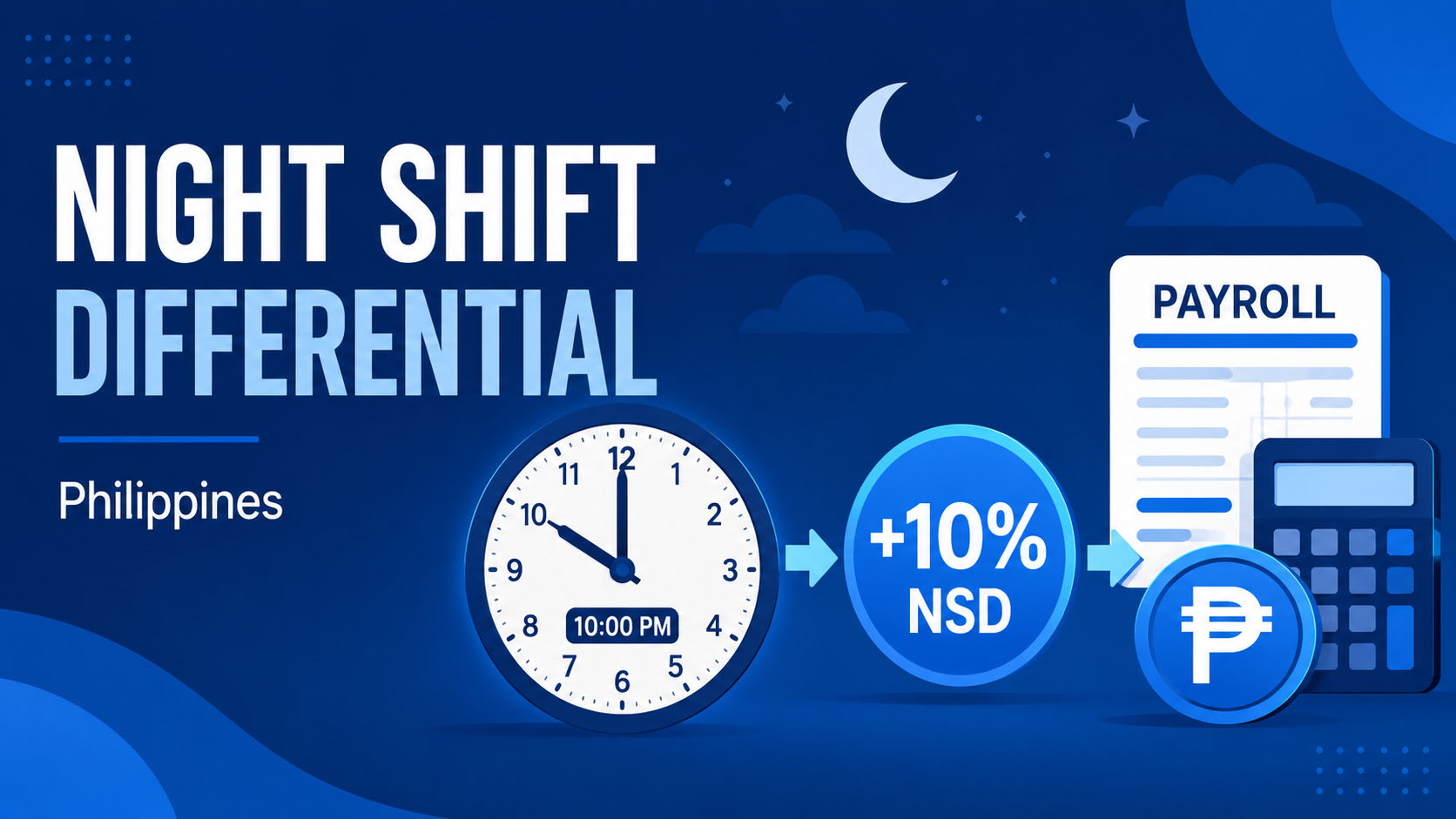
Night shift differential (NSD) is one of the more straightforward payroll rules in the Philippines: covered employees are generally entitled to an additional 10% for work performed between 10:00 PM and 6:00 AM.
The computation becomes more complicated when night work overlaps with overtime, rest days, special non-working days, regular holidays, meal breaks, and shifts that cross midnight.
There is also a practical problem that is often overlooked: what happens when employees have flexible unpaid break times but do not clock out for their breaks? If a shift includes both NSD and non-NSD hours, payroll may have no way of knowing whether the break occurred during the NSD period.
This guide goes beyond the basic 10% rule and explains how night shift differential works in actual payroll situations.
What Is Night Shift Differential (ND)?
Under Article 86 of the Labor Code of the Philippines, covered employees are entitled to additional compensation of at least 10% of their regular wage for each hour of work performed between 10:00 PM and 6:00 AM.
The statutory NSD period is therefore:
10:00 PM to 6:00 AM
For an ordinary working day, the basic formula is:
NSD = Hourly Rate × 10% × NSD Hours
For example, an employee with a ₱100 hourly rate who works eight compensable hours entirely within the NSD period receives:
₱100 × 10% × 8 = ₱80 NSD
The employee’s compensation would be:
Basic Pay: ₱800
Night Shift Differential: ₱80
Total: ₱880
Another way to express the total rate for those hours is:
100% × 110% = 110%
The NSD itself, however, is only the additional 10%.
What Hours Qualify for Night Shift Differential?
Only compensable hours actually worked between 10:00 PM and 6:00 AM qualify for NSD.
For example, suppose an employee works:
6:00 PM to 3:00 AM
Assuming the employee’s unpaid meal break occurs before 10:00 PM, the qualifying period is:
10:00 PM to 3:00 AM = 5 NSD hours
The hours worked between 6:00 PM and 10:00 PM do not receive NSD.
Similarly, an employee working:
3:00 AM to 12:00 PM
may receive NSD only for:
3:00 AM to 6:00 AM = 3 NSD hours
The employee does not have to be assigned to a schedule specifically called a “night shift.” What matters is the compensable work actually performed within the statutory NSD period.
Night Shift Differential and Meal Breaks
An unpaid meal period is generally not considered hours worked. An unpaid meal break that occurs during the NSD period should therefore generally be excluded when determining compensable NSD hours.
For example:
Schedule: 10:00 PM to 7:00 AM
Unpaid meal break: 2:00 AM to 3:00 AM
Although the schedule covers the entire 10:00 PM to 6:00 AM NSD window, the employee has only:
7 compensable NSD hours
This is why payroll should not simply calculate NSD based on the elapsed time between an employee’s time-in and time-out.
Flexible Break Times Can Create an NSD Computation Problem
A more difficult situation occurs when employees have a flexible unpaid meal break and are not required to clock out and back in when taking their break.
This may not create a significant payroll issue when the entire shift is either inside or outside the NSD period.
However, it becomes important when a shift contains both NSD and non-NSD hours.
Consider this schedule:
6:00 PM to 3:00 AM
1-hour unpaid flexible meal break
The portion of the shift falling within the statutory NSD period is:
10:00 PM to 3:00 AM
Now consider two employees with exactly the same schedule.
Employee A Takes the Break Before NSD
Employee A takes the one-hour break from:
8:00 PM to 9:00 PM
The break occurs outside the NSD period.
The employee therefore works:
10:00 PM to 3:00 AM = 5 NSD hours
Employee B Takes the Break During NSD
Employee B takes the break from:
11:00 PM to 12:00 AM
One hour of the break falls within the NSD period.
The employee therefore has:
4 compensable NSD hours
The employees have the same schedule, the same time-in, the same time-out, and the same one-hour unpaid break.
But they have different numbers of NSD hours.
What If Employees Do Not Record Their Break Time?
This creates an important attendance and payroll problem.
If employees are not required to clock out and back in for their flexible break, the attendance records for both employees may simply show:
Time In: 6:00 PM
Time Out: 3:00 AM
Payroll may know that a one-hour break must be deducted, but it does not know when that break actually occurred.
Was it 8:00 PM to 9:00 PM? or 11:00 PM to 12:00 AM?
That distinction changes the employee’s NSD computation.
A payroll system cannot determine information that was never captured by the attendance system.
Employers that allow flexible unpaid breaks should therefore establish a consistent policy for situations where the timing of the break affects payroll.
Depending on the company’s work arrangement, possible approaches may include:
- Requiring employees to clock out and back in for flexible unpaid breaks;
- Defining a standard meal-break period in the employee’s schedule; or
- Establishing another documented and consistently applied method for determining compensable hours.
The important payroll principle is that NSD should be based on compensable hours actually worked during the NSD period.
This illustrates a broader payroll principle:
Accurate payroll automation depends on having sufficient attendance data to determine which payroll rules apply to each hour worked.
Knowing only an employee’s time-in, time-out, and total break duration may not always be enough when different portions of a shift are subject to different pay rates.
NSD Can Overlap with Other Payroll Premiums
Night shift differential does not replace overtime, rest-day, or holiday premiums.
The same hour of work can potentially qualify for several payroll rules.
For example, an employee working at 11:00 PM might simultaneously be performing:
Night Work + Overtime + Rest-Day Work
Or the same hour could fall on a regular holiday.
This is where NSD computation becomes significantly more complicated than simply adding 10% to the employee’s hourly rate.
Night Shift Differential Rate Matrix
For the first eight hours of work, these are some common combinations:
| Situation | Computation | Effective Rate |
|---|---|---|
| Ordinary working day at night | 100% × 110% | 110% |
| Rest day at night | 130% × 110% | 143% |
| Special non-working day at night | 130% × 110% | 143% |
| Special day + rest day at night | 150% × 110% | 165% |
| Regular holiday at night | 200% × 110% | 220% |
| Regular holiday + rest day at night | 260% × 110% | 286% |
The important principle is that the NSD percentage is applied to the applicable wage rate for those hours. In order to compute ND you first need to determine the employees hourly rate and before hourly rate you need to compute employees daily rate.
Ordinary Working Day + Night Shift Differential
For ordinary night work:
Hourly Rate × 110%
For an employee earning ₱100 per hour:
₱100 × 110% = ₱110 per hour
The additional NSD is:
₱10 per hour
For eight qualifying hours:
₱110 × 8 = ₱880
Overtime + Night Shift Differential (NDOT)
Suppose an employee’s regular work ends at 10:00 PM, but the employee continues working until midnight.
The period from:
10:00 PM to 12:00 AM
is simultaneously:
Overtime + NSD
Ordinary-day overtime is generally paid at 125% of the hourly rate.
When the overtime falls within the NSD period:
Hourly Rate × 125% × 110%
Using a ₱100 hourly rate:
₱100 × 125% × 110% = ₱137.50 per hour
For two hours:
₱137.50 × 2 = ₱275
To compute this accurately you need to learn more about overtime pay rates in the Philippines.
Why Simply Adding OT and NSD Percentages Is Incorrect
A common payroll mistake is calculating:
100% + 25% OT + 10% NSD = 135%
That does not properly account for NSD on the applicable overtime rate.
Instead:
125% × 110% = 137.5%
For a ₱100 hourly rate, the difference is:
Incorrect: ₱135.00 per hour
Correct: ₱137.50 per hour
A ₱2.50 difference may appear small, but multiplied across employees, overtime hours, and payroll periods, it can result in substantial payroll discrepancies.
Rest Day + Night Shift Differential
Work during an employee’s rest day for the first eight hours is generally paid at:
130%
When performed during the NSD period:
130% × 110% = 143%
For a ₱100 hourly rate:
₱100 × 143% = ₱143 per hour
Special Non-Working Day + Night Shift Differential
For the first eight hours of work on a special non-working day:
130% × 110% = 143%
At a ₱100 hourly rate:
₱143 per covered night hour
If the special non-working day also falls on the employee’s rest day:
150% × 110% = 165%
At a ₱100 hourly rate:
₱165 per covered night hour
Regular Holiday + Night Shift Differential
For the first eight hours of work on a regular holiday:
200% × 110% = 220%
For a ₱100 hourly rate:
₱220 per covered night hour
If the regular holiday also falls on the employee’s rest day:
260% × 110% = 286%
For a ₱100 hourly rate:
₱286 per covered night hour
What About Overtime at Night on Rest Days and Holidays?
Several payroll rules may apply to the same hour:
Day Premium → Overtime Premium → Night Shift Differential
For example, overtime performed on a rest day is generally calculated by applying an additional 30% to the employee’s applicable rest-day rate.
The rate before NSD becomes:
130% × 130% = 169%
If that overtime occurs within the NSD period:
169% × 110% = 185.9%
For a ₱100 hourly rate:
₱100 × 185.9% = ₱185.90 per hour
The same principle applies when overtime overlaps with special days and regular holidays.
The applicable day rate should first be determined, followed by the applicable overtime premium and then the night shift differential.
A Realistic Payroll Example
Consider an employee with:
Daily Rate: ₱800
Hourly Rate: ₱100
Regular Schedule: 2:00 PM to 11:00 PM
Meal Break: 6:00 PM to 7:00 PM
The employee works until 1:00 AM.
The attendance can be divided into:
| Time | Classification |
|---|---|
| 2:00 PM–6:00 PM | Regular |
| 6:00 PM–7:00 PM | Unpaid meal break |
| 7:00 PM–10:00 PM | Regular |
| 10:00 PM–11:00 PM | Regular + NSD |
| 11:00 PM–1:00 AM | Overtime + NSD |
Regular Hours Before 10:00 PM
7 hours × ₱100:
₱700
Regular Hour with NSD
For the hour from 10:00 PM to 11:00 PM:
₱100 × 110% = ₱110
This consists of:
Basic Pay: ₱100
Night Shift Differential: ₱10
Overtime with NSD
For the two hours from 11:00 PM to 1:00 AM:
2 hours × ₱100 × 125% × 110% = ₱275
This consists of:
Overtime Pay: 2 × ₱100 × 125% = ₱250
NSD on Overtime: ₱250 × 10% = ₱25
Total Compensation
₱700 + ₱110 + ₱275 = ₱1,085
The total compensation for the shift is therefore ₱1,085.
Payroll Presentation May Be Different
The 110% and 137.5% rates above represent the combined effective rates. They do not necessarily represent how the amounts will appear on the employee’s payslip or payroll register.
Some companies and payroll systems present the basic compensation and night shift differential separately.
Using the same example, the payroll could instead be presented as:
| Payroll Item | Amount |
|---|---|
| Basic Pay – 8 hours | ₱800 |
| Overtime – 2 hours at 125% | ₱250 |
| Night Shift Differential – regular hour | ₱10 |
| Night Shift Differential – overtime hours | ₱25 |
| Total | ₱1,085 |
Under this presentation, the regular hour worked from 10:00 PM to 11:00 PM is not shown as a single 110% NSD rate. Instead, the employee receives:
100% as Basic Pay + 10% as Night Shift Differential
Likewise, the overtime hours may be presented as:
125% Overtime Pay + an additional 10% of the applicable overtime rate as NSD
Both presentations can arrive at the same total compensation.
This distinction is useful when reviewing payroll registers and payslips because an employee may see NSD as a separate earning item rather than seeing the entire covered hour paid at 110%.
The important point is not how the earnings are grouped or labeled in the payroll presentation, but whether the employee ultimately receives the correct basic pay, applicable premiums, and additional night shift differential.
Cross-Midnight Shifts: When Payroll Gets More Complicated
Another difficult payroll situation occurs when a shift crosses midnight.
Consider:
8:00 PM Monday → 5:00 AM Tuesday
Although this is one continuous shift, several important payroll boundaries occur:
8 PM → 10 PM → 12 AM → 5 AM
At 10:00 PM, NSD begins.
At 12:00 midnight, the calendar date changes.
That calendar-date change can become important when one of the dates is a holiday or rest day.
Example: A Shift Crosses Into a Regular Holiday
Suppose:
Monday: Ordinary working day
Tuesday: Regular holiday
The employee works:
Monday 8:00 PM to Tuesday 5:00 AM
The attendance potentially contains several classifications.
8:00 PM to 10:00 PM
Ordinary working hours outside the NSD period.
10:00 PM to 12:00 AM
Ordinary working hours within the NSD period.
12:00 AM to 5:00 AM
The employee remains within the NSD period, but the calendar date has changed to a regular holiday.
This raises an important payroll question:
Should the holiday classification change at midnight, or should the entire shift follow the holiday classification applicable to the employee’s work schedule?
Employers should have a clearly defined and consistently applied policy that complies with applicable labor rules.
This is particularly important for companies operating overnight or 24-hour shifts because the chosen treatment can affect not only holiday pay, but also NSD and overtime computations.
Calendar-Based vs. Shift-Based Holiday Treatment
Companies with overnight schedules commonly need to determine how holidays are recognized in their attendance and payroll system.
Depending on the employer’s applicable policy and work arrangement, holiday treatment may be configured based on:
Calendar Date
Hours are classified according to the actual calendar date on which they are worked.
or:
Shift
The holiday classification follows the employee’s scheduled shift according to the employer’s adopted policy.
Whichever approach applies, the employer should ensure that its policy is lawful, clearly defined, consistently implemented, and does not result in employees receiving less than their statutory entitlement.
Payroll and attendance systems should also be configured consistently with the employer’s adopted policy.
MPM Payroll can be configured to support different holiday and shift scenarios, allowing employers to align payroll computation with their established attendance and holiday policies.
You may read this article to know more about types of holidays in the Philippines and how they affect payroll.
Payroll Should Calculate by Time Segment, Not Just by Shift
A useful way to understand complicated NSD calculations is to divide attendance into payroll segments.
For each segment, determine:
- What day classification applies?
- Is the employee working regular hours or overtime?
- Does the time fall between 10:00 PM and 6:00 AM?
- Is the time compensable?
- What premium rate applies?
For example:
| Time | Classification | Applicable Treatment |
|---|---|---|
| 8 PM–10 PM | Ordinary | Regular rate |
| 10 PM–12 AM | Ordinary + NSD | Regular + NSD |
| 12 AM–2 AM | Holiday + NSD | Holiday rate + NSD |
| 2 AM–3 AM | Unpaid break | Not compensable |
| 3 AM–5 AM | Holiday + NSD | Holiday rate + NSD |
This approach becomes especially important when attendance crosses multiple payroll boundaries.
Common Night Shift Differential Payroll Mistakes
Applying NSD to the Entire Night Shift
An employee working from 6:00 PM to 3:00 AM does not automatically receive NSD for the entire shift.
Only qualifying compensable hours between 10:00 PM and 3:00 AM receive NSD.
Automatically Deducting the Break from NSD
Suppose an employee works 6:00 PM to 3:00 AM with a one-hour flexible break.
Automatically subtracting one hour from the five-hour NSD period assumes the break occurred after 10:00 PM.
If the employee actually took the break before 10:00 PM, that would understate the employee’s NSD hours.
Assuming the Break Occurred Outside NSD
The opposite assumption can also create an incorrect result.
If payroll always assumes that the flexible break occurred before 10:00 PM, an employee who actually took the break at midnight could receive NSD for an hour that was not worked.
The underlying problem in both situations is the same:
The attendance record does not contain enough information to determine when the break occurred.
Simply Adding OT and NSD Percentages
For ordinary-day overtime performed at night:
100% + 25% + 10% = 135%
is not the correct approach.
The applicable calculation is:
125% × 110% = 137.5%
Treating a Cross-Midnight Shift as One Payroll Block
Different portions of the same attendance record can potentially have different payroll classifications.
Relying on the Shift Name
An employee does not receive NSD merely because the schedule is called “Night Shift.”
Likewise, someone assigned to a daytime schedule may still earn NSD if actual compensable work extends beyond 10:00 PM.
Company Policies May Provide More Than 10%
The statutory NSD is a minimum.
Companies may provide a higher night differential through employment contracts, collective bargaining agreements, company policies, or established company practices.
For example, an employer may provide:
15% NSD
instead of 10%.
Payroll should therefore use the applicable company rate when the company provides a benefit greater than the statutory minimum.
Automating Night Shift Differential in Payroll
The mathematical formula for night shift differential is simple.
The difficult part is determining which formula applies to each hour.
A payroll system may need to evaluate:
Attendance → Schedule → Breaks → Compensable Hours → Day Classification → Regular/OT → NSD → Applicable Rate
For companies operating multiple shifts, these rules can produce several different rates within a single attendance record.
The quality of the computation also depends on the quality of the attendance information.
If employees are allowed to take flexible unpaid breaks without recording their actual break times, even an automated payroll system may not have enough information to determine exactly how many NSD hours were worked.
Automation can calculate the rules — but it cannot reconstruct attendance information that was never recorded.
Automate NSD Computation with MPM Payroll
MPM Payroll integrates attendance and payroll computation so employers can process night shift differential together with other applicable payroll rules.
Depending on the company’s configuration, MPM Payroll can help process:
- Night shift differential
- Overtime
- Rest-day work
- Special non-working days
- Regular holidays
- Cross-midnight attendance
- Flexible and fixed employee schedules
- Other payroll adjustments
Attendance can also be captured through Web Bundy, Employee Self-Service (ESS), or supported biometric attendance integrations, reducing manual encoding between attendance and payroll.
MPM Payroll can also be configured for different holiday and shift scenarios, helping companies align the system with their established payroll and attendance policies.
Make Philippine payroll computation easier with MPM Payroll.
Frequently Asked Questions
What time does night shift differential start in the Philippines?
How much is night shift differential?
An employer may provide a higher rate.
Is night shift differential computed on overtime?
For ordinary-day overtime performed at night:
125% × 110% = 137.5%
Is NSD paid on a regular holiday?
For the first eight hours of regular-holiday work at night:
200% × 110% = 220%
What if a regular holiday falls on the employee's rest day?
260% × 110% = 286%
What if the employee's break time is flexible?
If employees do not record their break times, payroll may not have enough attendance information to determine the exact NSD hours. Employers should establish a consistent policy or attendance procedure for handling these situations.
Does an employee have to clock out for a meal break?
What if an employee's shift crosses midnight into a holiday?
Employers should ensure that their holiday policy and payroll configuration correctly determine which holiday, overtime, and NSD rules apply to each portion of the shift.
Does an employee working until 11:00 PM receive NSD?
Only the work performed from:
10:00 PM to 11:00 PM
would qualify for NSD.
Does an employee starting work at 4:00 AM receive NSD?
Compensable work from:
4:00 AM to 6:00 AM
falls within the statutory NSD period.
Is night shift differential the same as overtime?
Overtime pay compensates covered employees for qualifying work beyond normal working hours.
Night shift differential provides additional compensation for qualifying work performed during the statutory night period.
An hour can qualify for both overtime and NSD.
Key Takeaway
The basic night shift differential rule is easy to remember:
Covered work between 10:00 PM and 6:00 AM receives at least an additional 10%.
Actual payroll computation is more complicated because a single hour can potentially be:
Night Shift + Overtime + Rest Day/Holiday
Breaks can create another complication. If an employee’s shift contains both NSD and non-NSD hours and the employee takes a flexible unpaid break, the actual time of the break can change the employee’s NSD hours.
If that information is not captured, payroll cannot reliably determine when the non-compensable hour occurred.
For accurate payroll, employers therefore need more than formulas. They need clear attendance policies, sufficient attendance data, and payroll rules that correctly classify each portion of an employee’s work.
That becomes particularly important for businesses with night shifts, flexible breaks, overtime, rotating schedules, holidays, and 24-hour operations.
Automate Night Shift Differential with MPM Payroll
Computing night shift differential becomes more complex when employees have different schedules, overtime, rest days, holidays, and work that crosses midnight.
MPM Payroll automatically calculates night shift differential based on the employee’s attendance, work schedule, hourly rate, and applicable payroll rules. It can also handle situations where night work overlaps with overtime, rest days, and holidays—helping reduce manual calculations and payroll errors.
With integrated attendance and payroll, you can spend less time calculating premiums manually and more time reviewing and approving payroll.
Simplify your payroll computation with MPM Payroll or let our team handle it with our Outsource Payroll Services.

Leave a Reply