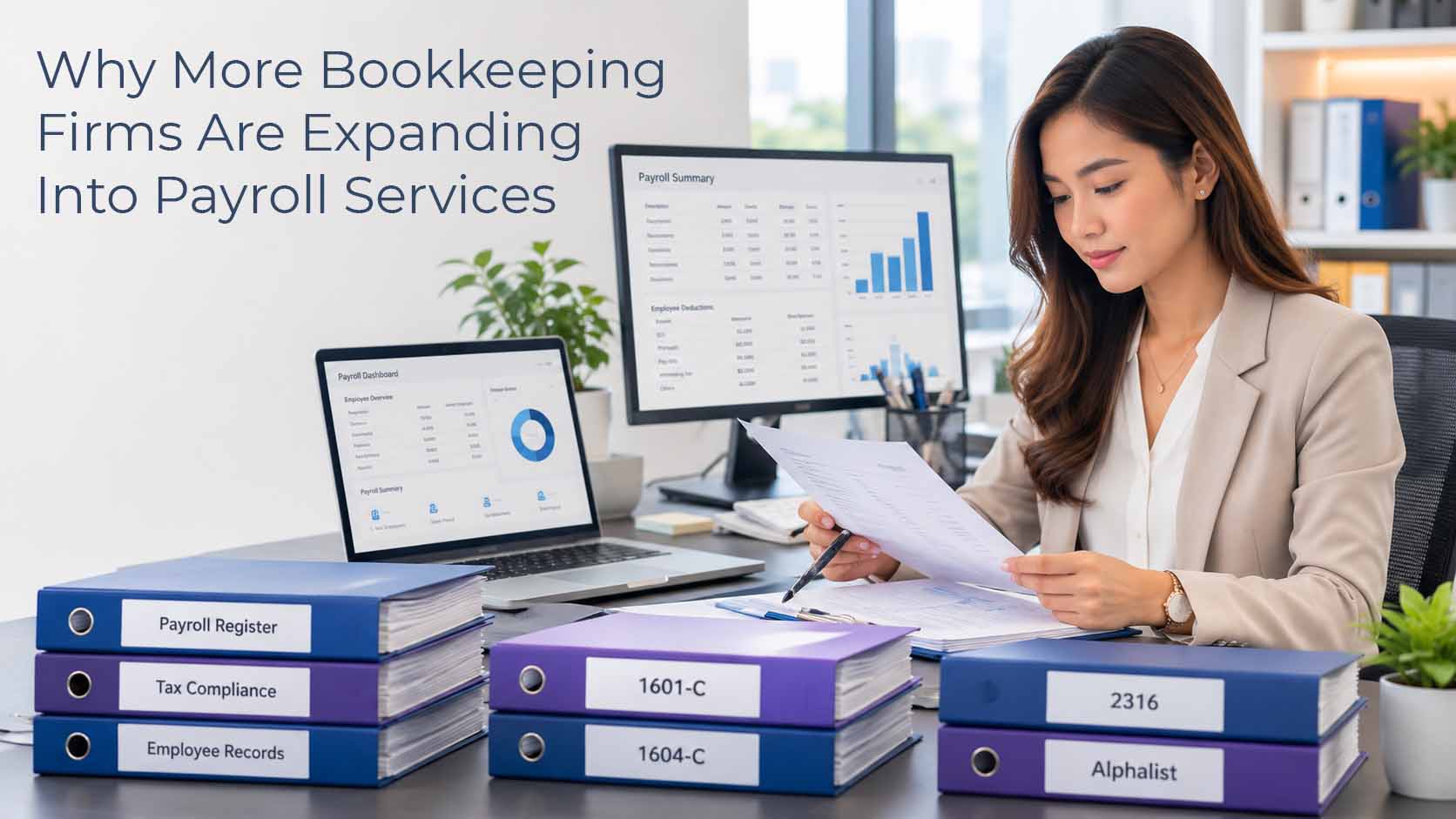
Many bookkeeping firms started by offering accounting, tax preparation, and compliance services. Today, an increasing number are also providing payroll services – and for good reason.
Payroll has evolved from being a simple salary computation into a critical business process that directly affects tax compliance, accounting accuracy, employee satisfaction, and government reporting.
As businesses look for trusted partners who can handle multiple back-office functions, bookkeeping firms are discovering that payroll is a natural extension of the services they already provide.
What We’ve Observed After Working With Bookkeeping Firms
Over the years, we’ve worked closely with bookkeeping firms, accounting firms, payroll service providers, and tax practitioners across the Philippines. We’ve seen firms evolve from manually processing payroll for a handful of clients to managing payroll for organizations with hundreds of employees. A common factor in that growth has been the adoption of standardized payroll processes and software that automates calculations, compliance, and reporting. Several firms using MPM Payroll have expanded their capacity to serve larger clients without having to grow their payroll team at the same pace.
Interestingly, these firms rarely decide to offer payroll simply to create another revenue stream. More often, they discover that payroll has become an essential part of delivering accurate bookkeeping, tax compliance, and year-end BIR reporting. Once payroll and accounting work together, firms become more efficient, reduce reconciliation work, and can confidently take on larger and more complex clients.
Payroll Is a Natural Extension of Bookkeeping
Bookkeepers already work with financial records, tax filings, and statutory compliance. Payroll fits naturally within this workflow because employee compensation is one of the largest recurring expenses for most businesses.
Instead of relying on clients to provide payroll summaries each month, firms that manage payroll themselves have direct access to accurate payroll data, making bookkeeping and reporting significantly more efficient.
For many firms, payroll isn’t a completely new service – it’s simply completing the financial picture they are already responsible for.
Existing Clients Already Need Payroll Services
One of the biggest advantages bookkeeping firms have is an existing client base.
Many of their clients already need payroll processing but are still relying on spreadsheets, manual computations, or a separate payroll provider.
By offering payroll services, bookkeeping firms can:
- Increase recurring monthly revenue
- Strengthen client relationships
- Reduce client reliance on multiple service providers
- Expand services without acquiring entirely new clients
Growing revenue from existing clients is often easier and more cost-effective than finding new ones.
Payroll Makes Tax Compliance Significantly Easier
For many bookkeeping firms and tax practitioners, payroll isn’t just about paying employees – it is an essential part of tax compliance.
Clients frequently expect their accountant or tax preparer to prepare payroll-related BIR reports such as:
- BIR Form 1601-C (Monthly Remittance Return of Income Taxes Withheld on Compensation)
- BIR Form 1604-C (Annual Information Return of Income Taxes Withheld on Compensation)
- BIR Form 2316 (Certificate of Compensation Payment/Tax Withheld)
- Alphalist of Employees
When payroll is processed by another provider – or manually through spreadsheets—preparing these reports becomes much more difficult.
Before the reports can even be prepared, bookkeeping firms often need to:
- Request payroll registers from clients
- Verify employee earnings and taxable compensation
- Reconcile withholding tax computations
- Correct inconsistencies between payroll records and accounting records
- Investigate discrepancies discovered during year-end reporting
These additional reconciliation steps consume valuable time and increase the risk of reporting errors.
When the bookkeeping firm also manages payroll using a reliable payroll system, payroll records, tax computations, statutory deductions, and employee information are already available in one place. This significantly simplifies the preparation of payroll-related BIR reports and reduces year-end workload.
Instead of spending time correcting payroll data, accountants can focus on reviewing reports, ensuring compliance, and providing higher-value advisory services.
Payroll Creates Predictable Recurring Revenue
Unlike many accounting engagements that are seasonal or project-based, payroll follows a regular schedule.
Employees need to be paid every payroll period regardless of market conditions.
This creates predictable monthly recurring revenue that helps bookkeeping firms build a more stable business.
As firms add more payroll clients, they create a growing stream of recurring income alongside their bookkeeping and tax services.
Clients Prefer Working With Fewer Service Providers
Business owners increasingly prefer working with fewer vendors.
When bookkeeping, tax preparation, payroll processing, and compliance reporting are handled by different providers, communication gaps and duplicated work often occur.
Offering payroll services allows bookkeeping firms to become a single trusted partner for their clients.
This not only improves efficiency but also strengthens long-term client relationships.
Payroll Improves Accounting Accuracy
Payroll represents one of the largest operating expenses for many businesses.
When payroll data arrives late or contains errors, accountants often spend additional time reconciling payroll journals, employee benefits, government contributions, and withholding taxes.
Managing payroll internally provides immediate access to payroll information, resulting in:
- Faster month-end closing
- More accurate payroll journal entries
- Better expense tracking
- Reduced reconciliation work
- Improved financial reporting
Integrated payroll and accounting workflows eliminate much of the manual effort associated with maintaining separate systems.
Modern Payroll Software Makes Scaling Easier
Years ago, offering payroll services meant maintaining complicated spreadsheets and manually computing salaries, taxes, and government contributions.
Today’s payroll software automates much of the work, including:
- Payroll computations
- Overtime and leave calculations
- SSS, PhilHealth, and Pag-IBIG contributions
- Withholding tax computations
- Payslip generation
- Government reports
- Employee self-service
- Attendance integration
Automation allows bookkeeping firms to serve more payroll clients without proportionally increasing their administrative workload.
Standardized Payroll Processes Reduce Operational Risk
As bookkeeping firms grow, maintaining consistent payroll processes becomes increasingly important.
When payroll procedures exist only in spreadsheets or rely heavily on the knowledge of a single employee, staff turnover can create significant operational challenges.
Modern payroll systems centralize payroll configurations, company policies, employee earnings, deductions, schedules, and compliance rules.
This creates standardized processes that are easier to document, review, and transfer between staff members.
The result is better business continuity, shorter onboarding time for new employees, and more consistent service delivery.
Payroll Strengthens Long-Term Client Relationships
Payroll is one of the most sensitive functions within any business.
Clients depend on payroll providers to ensure employees are paid accurately, statutory deductions are computed correctly, and compliance deadlines are met.
Because payroll is processed every payroll cycle, bookkeeping firms interact with clients regularly rather than only during month-end or tax season.
These ongoing interactions naturally strengthen client relationships and often create opportunities to provide additional services, including:
- Bookkeeping
- Accounting
- Tax compliance
- Financial reporting
- Business advisory
- HR and workforce management support
Payroll often becomes the gateway to a broader and longer-lasting professional relationship.
Is Payroll Expansion Right for Your Firm?
For bookkeeping firms looking to grow, payroll services represent a logical next step.
The demand already exists among many current clients, the revenue is recurring, and modern payroll software has significantly reduced the complexity of payroll processing.
Perhaps more importantly, payroll enables firms to deliver a more complete compliance solution. Instead of reconciling payroll information prepared elsewhere, firms gain direct control over the data needed for accounting, tax filings, and government reporting.
As regulatory requirements continue to evolve, firms that offer payroll services are often better positioned to deliver efficient, integrated, and higher-value services to their clients.
Ready to Add Payroll Services to Your Firm?
Expanding into payroll doesn’t mean you have to build everything from scratch.
MPM Payroll is designed specifically for bookkeeping firms, accounting firms, and payroll service providers that want to offer professional payroll services while maintaining accuracy and compliance.
The platform helps automate:
- Payroll processing
- SSS, PhilHealth, and Pag-IBIG computations
- Withholding tax calculations
- Employee self-service
- Attendance integration
- Government reports
- Payroll-related BIR reports
Whether you’re adding payroll as a new service or replacing manual spreadsheets, MPM Payroll provides the tools to help your firm serve more clients efficiently.
Interested in learning more? Contact us to schedule a personalized demonstration and discover how our payroll software and partner pricing program can help your firm expand into payroll services with confidence.
Payroll is no longer just an administrative function. It has become an integral part of bookkeeping, accounting, and tax compliance.
Firms that manage payroll alongside their accounting services gain better visibility into payroll data, reduce reconciliation work, simplify the preparation of payroll-related BIR reports, and provide a more seamless experience for their clients.
As businesses increasingly seek trusted partners who can manage multiple compliance functions under one roof, expanding into payroll is no longer simply an additional service – it is becoming a strategic advantage for modern bookkeeping firms.

Leave a Reply